
VerifiedFact Checked
Why does food taste different on a GLP-1?

Why does food taste different on a GLP-1?

Both obesity and GLP-1 injections can affect taste sensitivity through various mechanisms, such as changes in brain chemistry and activation of taste buds. GLP-1 medications can also encourage you to slow down while eating and reduce the addictive aspects of food. This allows you to eat mindfully, helping reduce cravings and food noise, and improving your appreciation of food.

Start Your Weight Managemnet Journey

Sanjeda Chowdhury
Medically reviewed by
Sanjeda Chowdhury, Superintendent Pharmacist + Independent Prescriber
Go to
Reviewed on Oct 28, 2026. by Ms Sanjeda Chowdhury Superintendent Pharmacist + Independent Prescriber Registered with GPhC (No. 2202465) Next review due on Oct 28, 2029.
Sanjeda

Last updated on Nov 11, 2026.

Was this article useful?

The science between GLP-1s and taste perception

Obesity can change how food tastes to you, especially sweet foods. So something sweet might not taste as sweet to you because, over time, obesity can dampen your sensitivity to sweetness. So when you start to lose weight with a GLP-1, your perception of food can change significantly. Here’s how:

Reversing weight-related taste blindness

Research suggests that obesity may be associated with changes in taste sensitivity, particularly for sweet foods. Leptin, a hormone primarily involved in regulating appetite and energy, might also influence sweet taste perception. Higher leptin levels have been associated with dampening your sweet sensitivity, meaning that a greater concentration of sweetness is needed for it to be detected. One study reported that when leptin levels peaked in the morning, participants needed a higher concentration of sucrose and saccharin than in the evening when levels were lower. This shows that there is a possible relationship between leptin and sweet taste sensitivity. Leptin levels are also generally higher in people with a higher BMI, which is why people with obesity might need a higher sugar concentration to taste sweetness. 

Weight loss is also associated with reductions in circulating leptin levels. One study found that women who lost weight had improved sweet-taste sensitivity as leptin levels decreased. This suggests that leptin could contribute to changes in taste perception during weight loss.

People taking GLP-1 weight loss injections might also experience changes in their perception of food and their preferences for sweet foods. As they lose weight, leptin levels decrease, which can enhance sensitivity to sweet tastes. While we can assume that this change is linked to the decrease in leptin levels, there’s currently no direct evidence to confirm this correlation.

Taste bud sensitivity

“Ozempic tongue” refers to the changes in taste experienced by people taking GLP-1 injections. These changes can include dysgeusia, which is a change in the way food tastes, and dry mouth. Some users of GLP-1 injections have reported a persistent metallic or bitter taste in their mouths.

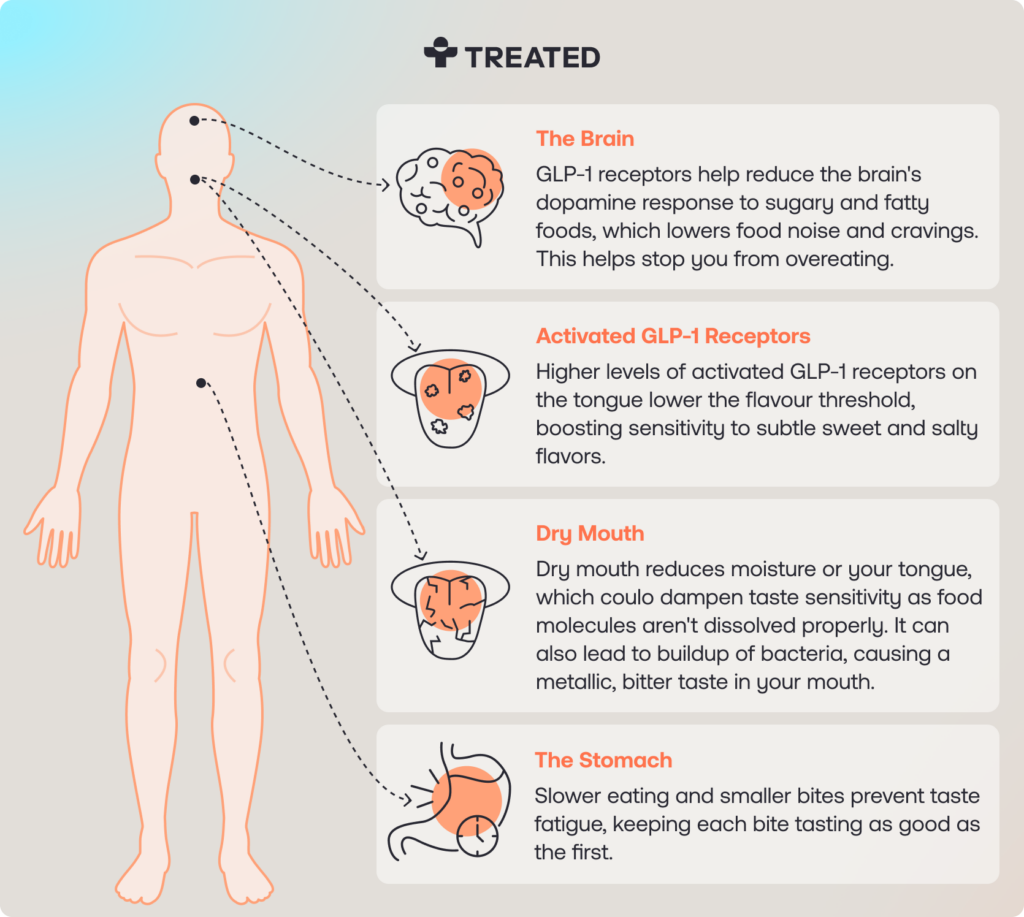
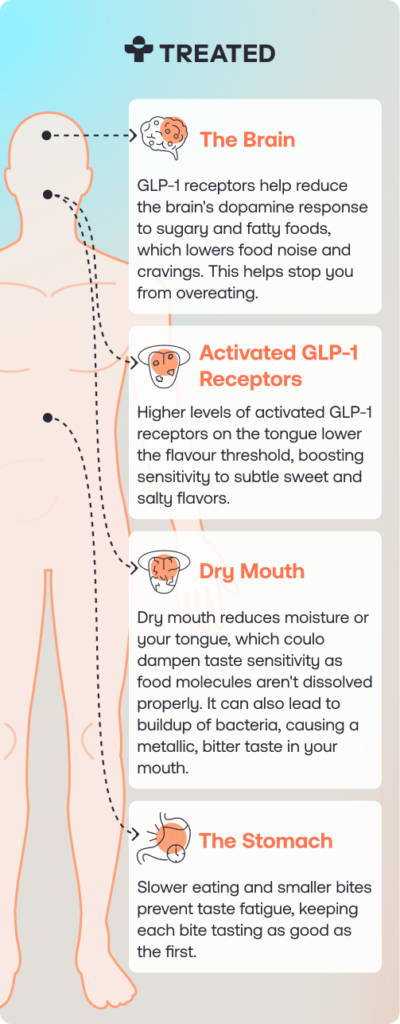
The reason behind dysgeusia can be attributed to GLP-1 receptors located on the tongue. When you take GLP-1 injections, these receptors are activated, potentially altering taste perception, particularly for sweet and umami flavors. A study in mice found that a deficiency in GLP-1 receptors resulted in reduced sensitivity to sweet foods. So increasing GLP-1 levels may heighten sensitivity to sweet and umami tastes.

Additionally, dry mouth can affect your perception of flavour. Saliva helps dissolve food, allowing flavour molecules to be recognised by your taste buds. Without sufficient moisture, your taste buds cannot effectively process food molecules, which may result in less flavourful experiences. So a lack of saliva can lead to a buildup of bacteria, which can leave a metallic or bitter taste in your mouth.

While dysgeusia and dry mouth can have opposing effects – one enhancing the perception of taste while the other diminishes it – the overall impact depends on which condition is more pronounced. This is why individuals taking GLP-1 injections report varying taste experiences. Some may find foods overly sweet, while others may perceive them as bland. The differences depend on how GLP-1 injections interact and respond within your body.

Dopamine and the brain

Dopamine is a neurotransmitter involved in processing food, motivation, and reward. When you eat food, particularly ‘junk foods’ or sweet foods, it activates the dopamine pathway. Similarly to addiction, this pathway makes you feel good and want more. Known as the mesolimbic reward system, this reward response can lead to intense cravings and overeating.

People with obesity also often have lower levels of dopamine, which may contribute to food cravings that further contribute to weight gain.

GLP-1 receptors are found in the brain and can affect the mesolimbic reward system. Activating GLP-1 receptors can help dampen the brain’s dopamine response to sugary and fatty foods, thereby reducing food cravings. This change can help people to overeat less, as eating no longer triggers that same dopamine pathway, helping to tone down the overwhelming noise around food and make it feel less exciting.

Why some foods taste different

GLP-1 injections can affect taste sensitivity, causing some foods to taste overwhelmingly sweet. It can also reduce appetite, food noise, and cravings, which may lead people to enjoy food less. They might naturally shift from ultra-processed foods that can start to taste excessively sweet or greasy, to more whole foods.

Activated GLP-1 receptors
Activated GLP-1 receptors_m

Mindful eating: Why less is more

Mindful eating can actually help you appreciate food and manage your cravings and food noise. By paying full attention to each bite and savouring it, you can experience greater enjoyment from your meals.

Avoid eating while watching TV or using your phone, as these distractions can take focus away from the food. This can lead to a feeling that you haven’t eaten much, even when you actually have.

Beating ‘sensory-specific satiety’

When you eat quickly or in large portions, you may have less time to fully appreciate the taste of your food. Saliva helps dissolve food particles, allowing taste receptors to detect different flavours. Eating too quickly may reduce the time available to savour these flavours.

Eating quickly can also make it harder to pay attention to the different flavours and textures of food. One bite might contain sweet, umami and salty flavours, but eating rapidly may leave you with less time to appreciate their complexity. 

Additionally, a large part of flavour perception is related to smell. As you chew, food aromas travel from the back of your mouth into your nasal cavity, where they contribute to your perception of flavour. Eating too quickly may reduce the opportunity to appreciate these aromas, affecting your overall eating experience.

By paying attention to what you eat and slowing down, you can savour each bite and become more aware of your hunger and fullness cues. Avoid eating while watching TV or using your phone, as these distractions can draw your attention away from your food. This may make it harder to recognise how much you have eaten and how satisfied you feel.

GLP-1 can help you slow down and eat more mindfully. Side effects such as nausea and reduced appetite can lead to smaller portion sizes, allowing you to savor every bite. Additionally, GLP-1’s effects on the dopamine pathway may reduce the desire to eat for enjoyment, prompting you to choose healthier options instead of unhealthy foods.

Reference Popover #ref1
Reference Popover #ref2
Reference Popover #ref3
Reference Popover #ref4
Reference Popover #ref5
Reference Popover #ref6

How we source info.

When we present you with stats, data, opinion or a consensus, we’ll tell you where this came from. And we’ll only present data as clinically reliable if it’s come from a reputable source, such as a state or government-funded health body, a peer-reviewed medical journal, or a recognised analytics or data body. Read more in our editorial policy.

Tell us what you want to hear.

Have a subject you’d like us to cover in a future article? Let us know.

Give us the inbox treatment.

We're making healthcare more about you. Sign up to our newsletter for personalised health articles that make a difference.

Disclaimer: The information provided on this page is not a substitute for professional medical advice, diagnosis, or treatment. If you have any questions or concerns about your health, please talk to a doctor.