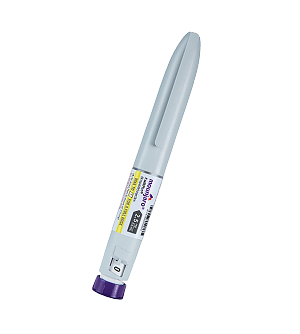

- Mounjaro (tirzepatide) helps you lose weight by making you feel full and preventing you from overeating.
- It’s a weekly injection used by people with high BMI or weight-related health issues.
- Side effects like nausea are common, especially after increasing the dose.
- It should be used alongside diet and exercise to achieve the best results.
How does tirzepatide (Mounjaro) work?
Tirzepatide is a GLP-1 and GIP receptor agonist. It mimics the action of two natural ones found in your body, and works in three main ways to prevent you from overeating:
- Suppresses your appetite, which helps you feel less hungry and less likely to reach for food.
- Delays stomach emptying, which makes you feel fuller for longer.
- Increases satiety, meaning you’ll feel full and satisfied sooner than usual.
Tirzepatide also enhances insulin secretion, which helps improve blood sugar control. This helps you lose weight as it makes your body more efficient at burning sugar and less likely to store it as fat.
How long does tirzepatide take to work?
Tirzepatide starts working within hours and reaches peak concentrations between days one and two. After this, it stays at active levels in your body until around day seven – but this is when you’ll take another dose.
Although tirzepatide works fast, it can take a few weeks to achieve noticeable weight loss. Many people start seeing a significant difference by week four.
What forms of tirzepatide are available?
Tirzepatide is only available as an injection under the brand names Mounjaro or Zepbound in the USA.
Currently, there aren’t any oral forms of GLP-1 weight loss injections, and it’s unknown whether they’ll be available in the near future.

Who can take tirzepatide (Mounjaro)?
Those who have a body mass index (BMI) of 30, or a BMI of 27 with a weight-related health problem, like diabetes or cardiovascular disease, can take Mounjaro.
In rare cases, a clinician might prescribe it to someone with a BMI of 27 without any weight-related conditions, if they think it will be beneficial – but this would be considered off-label use.

When was Mounjaro released?
Mounjaro was created by Eli Lilly, an American pharmaceutical company. It was approved for weight management in the UK in November 2023. Prior to this, Saxenda (liraglutide), another weight loss injection, was approved in 2017. GLP-1 weight loss injections have been around for a while and show many promising results.
While Saxenda was effective for weight loss, Mounjaro was a breakthrough as it only required weekly injections as opposed to daily with Saxenda. This made it more convenient for patients to use. Its dual actions also make it more effective than Saxenda or Wegovy , helping patients achieve weight loss in a shorter treatment period.
How to use tirzepatide (Mounjaro)
- Mounjaro is injected once weekly around the same time.
- It’s injected either in your upper arms, thighs, or abdomen.
- There are six doses – you’ll remain on each dose for four weeks until you reach the maintenance dose.
- You should exercise and diet alongside your injection for optimal results.
How to inject your Mounjaro Kwikpen
Preparing Mounjaro:
- Wash your hands.
- Check that the pen is the correct dose and the liquid is colourless or slightly yellow. It shouldn’t be cloudy or frozen.
- Wipe the inner seal.
- Push a new capped needle onto the pen and twist until it’s tight.
- Remove the outer needle cap and keep it aside.
- Remove the inner needle shield and discard it.
- Turn the dose knob until you hear two clicks.
- Hold the pen upright and gently tap it to remove any bubbles.
- Push the dose knob to remove some medicine until the icon shows ‘0’.
Injecting Mounjaro:
- Choose your injection site.
- Turn the dose knob until it shows ‘1’.
- Insert the needle into your skin.
- Push the dose knob until the icon shows ‘0’.
After injecting Mounjaro:
- Replace the outer needle cap on the injection.
- Unscrew the needle and dispose of it appropriately.
- Replace the pen and store it at room temperature.
For detailed information on how to use Mounjaro, check the patient information leaflet.
When is the best time to inject Mounjaro?
You can inject Mounjaro any time of the day – just make sure it’s at a time where you’ll be free each week.
Some people may get side effects like nausea or an upset stomach within a couple of hours or the following day. Take this into consideration when scheduling your injection. For example, if you get side effects after 12 hours, consider injecting in the morning so you can sleep through them, or inject on the weekend so you don’t have to deal with side effects if you’re at work during the week.
What to do if you miss a dose of Mounjaro
If it’s been less than four days since the forgotten dose, just inject it as soon as you remember.
If it’s been more than four days since your last dose, skip the missed dose and take the next one at the scheduled time. You should have at least three days between two doses.
Taking a double dose or two doses close together can lead to overdose symptoms, such as very low blood sugar levels.
How and when to increase your Mounjaro dose
There are six doses of Mounjaro: 2.5mg, 5mg, 7.5mg, 10mg, 12.5mg, and 15mg.
You’ll typically increase your dose every four weeks until you reach the maintenance dose on week 21. There are some instances where you might remain on the same dose for a longer period.
When to stay on the same dose of Mounjaro for longer
Sometimes staying on the same dose for longer can be beneficial. For example, if the side effects persist, moving up a dose is likely to make them worse. So it’s best to remain on the lower dose until your body has had more time to get used to the drug. While this might slow down your weight loss progress, it means you’re more likely to stick with the medication in the long term.
Another reason to stay on a lower dose might be cost. The cost of Mounjaro increases with higher doses. At time of writing, the 2.5mg dose costs around £190 a month, compared to £280 for the 12.5mg and 15mg doses. It’s better to stay on a lower dose than not use Mounjaro at all, as stopping can cause you to gain back the lost weight.
Additionally, your clinician might suggest remaining on the 10mg maintenance dose, rather than the recommended 15mg maintenance dose. This is because studies show that there isn’t much difference in weight loss between the two doses (10mg and 15mg), yet it’s more cost-effective.
If you wish to stay on the same dose of Mounjaro for an extended period, message your clinician before your medicine is shipped, explaining why.
What to do if you take a break from Mounjaro
If you take a break from Mounjaro, you may not be able to resume at the same dose as before.
If it’s been more than four weeks, you’ll probably have to go back to the starting dose. This is because Mounjaro will have left your body, and its effect won’t remain. So when you restart, you’ll need to reintroduce gradually to reduce the risk of side effects.
If you plan to skip a week of Mounjaro, perhaps for a holiday, inform your clinician. This short pause shouldn’t significantly impact your weight loss, as the small amounts of medicine will remain in your body. But this should only be an occasional occurrence, not a regular habit.
How to store your Mounjaro Kwikpen
To store an unused pen, keep it in the refrigerator between 2°C to 8°C until the expiration date.
Store used pens at room temperature (up to 30°C) for 30 days after the first use.
Always check the liquid before injecting to make sure it’s colourless or slightly yellow. If it looks cloudy or is frozen, don’t use the pen.
How to dispose of your Mounjaro Kwikpen
Dispose of the needle and the pen in a disposable sharps bin. This is typically a small yellow bin with a little lid on top. When the bin is full, dispose of it according to your local household waste regulations, usually by returning it to a pharmacy or designated collection point.
Diet and exercise when using tirzepatide
You should incorporate a healthy diet and exercise plan while using weight loss injections to get the best results. Aim to eat around 1500 calories a day if you’re a woman and 2000 if you’re a man, making sure a high proportion of it is protein (around 50g per day is a good guide). Include plenty of vegetables, fruits, nuts, and whole grains.
Try to exercise for at least 150 minutes per week, incorporating both moderate-intensity cardio and strength training to help maintain muscle mass.
Mounjaro and alcohol
You don’t have to completely cut out alcohol, but it’s good to limit your intake. Alcohol can worsen your side effects like nausea, vomiting, and fatigue, particularly during dose increases.
Additionally, it might hinder your weight loss by adding extra calories and potentially increasing your appetite. A typical beer or cocktail can contain around 200 calories. If you choose to drink alcohol, it’s important to include these calories in your daily intake.
Can tirzepatide cause side effects?
Yes, there’s a chance you might get side effects when taking Mounjaro. Some of the more common side effects include nausea, vomiting, upset stomach, and digestive issues. These side effects should subside as your body adjusts to the treatment, but if they don’t, inform your clinician. After each dose increase, the side effects will temporarily worsen again, but they settle down within a few days.
Tirzepatide contraindications and interactions
Tirzepatide has no contraindications, but there are a couple of medications you should avoid when using Mounjaro.
You should be careful if you’re taking tirzepatide alongside your diabetes medication like insulin, acarbose, and glipizide – there’s a risk of getting hypoglycemia (low blood sugar levels).
Tirzepetide also decreases the effectiveness of oral contraceptives by delaying stomach emptying, which affects their absorption. It’s best to use a barrier method of contraception or switch to a non-oral form (like an IUS or IUD) for the first 4 weeks of treatment, and for 4 weeks after each dose increase.
Who shouldn’t use tirzepatide?
Let your clinician know if you have any of the following conditions:
- Severe problems with food digestion
- Have pancreatitis
- Diabetic retinopathy or macular oedema
- You’re using another diabetes medication
These conditions may make it unsuitable for you to use Mounjaro or may require closer monitoring.
Can Mounjaro be used during pregnancy or breastfeeding?
Don’t use Mounajro if you’re pregnant, as it’s unknown whether the effect of tirzepatide will affect your baby. Likewise, it’s unknown whether tirzepatide passes into breastmilk, so you should avoid using it if you’re breastfeeding.
Make sure to use a barrier form of contraception or a non-oral contraceptive to prevent accidentally getting pregnant. If you happen to get pregnant, stop using Mounjaro and inform your doctor straight away.
How to get tirzepatide
You can get Mounjaro through the NHS or from a private pharmacy. The NHS has stricter criteria for Mounjaro, requiring a BMI of 40 or 37.5 with an accompanying risk factor, and they may have longer waiting times.
If you meet the criteria for Mounjaro and are looking to lose weight, you can get it through an online pharmacy such as Treated. Simply answer a few questions about your health and medical history, so a clinician can check whether Mounjaro is safe and suitable for you.
Reference Popover #ref1
Treated trusted source
Farzam K, Patel P.
Tirzepatide. [Updated 2024 Feb 20]. In: StatPearls [Internet]. Treasure Island (FL): StatPearls Publishing; 2025 Jan-.
Reference Popover #ref2
Treated trusted source
Jastreboff, A.M., et al. (2022).
Tirzepatide Once Weekly for the Treatment of Obesity. New England Journal of Medicine, [online] 387(3).
Reference Popover #ref4
Treated trusted source
MHRA (2023).
MHRA authorises diabetes drug Mounjaro (tirzepatide) for weight management and weight loss.
Reference Popover #ref5
Treated trusted source
West Yorkshire Area Prescribing Committee (2017).
Commissioning Statement: Liraglutide for obesity.
Reference Popover #ref6
Treated trusted source
Teng, Y., Fan, X., Yu, R. and Yang, X. (2024).
Evaluation and comparison of efficacy and safety of tirzepatide, liraglutide and SGLT2i in patients with type 2 diabetes mellitus: a network meta-analysis. BMC Endocrine Disorders, 24(1).
This page was medically reviewed by Dr Alexandra Cristina Cowell, Writer & Clinical Content Reviewer on Aug 15, 2025. Next review due on Aug 15, 2028.
Last updated on Aug 15, 2025.
How we source info.
When we present you with stats, data, opinion or a consensus, we’ll tell you where this came from. And we’ll only present data as clinically reliable if it’s come from a reputable source, such as a state or government-funded health body, a peer-reviewed medical journal, or a recognised analytics or data body. Read more in our editorial policy.
Let’s help you choose better.
Find treatment



Treated
Authorised and Regulated by: