Home | Blog | Weight Loss | When does Mounjaro peak in the body?
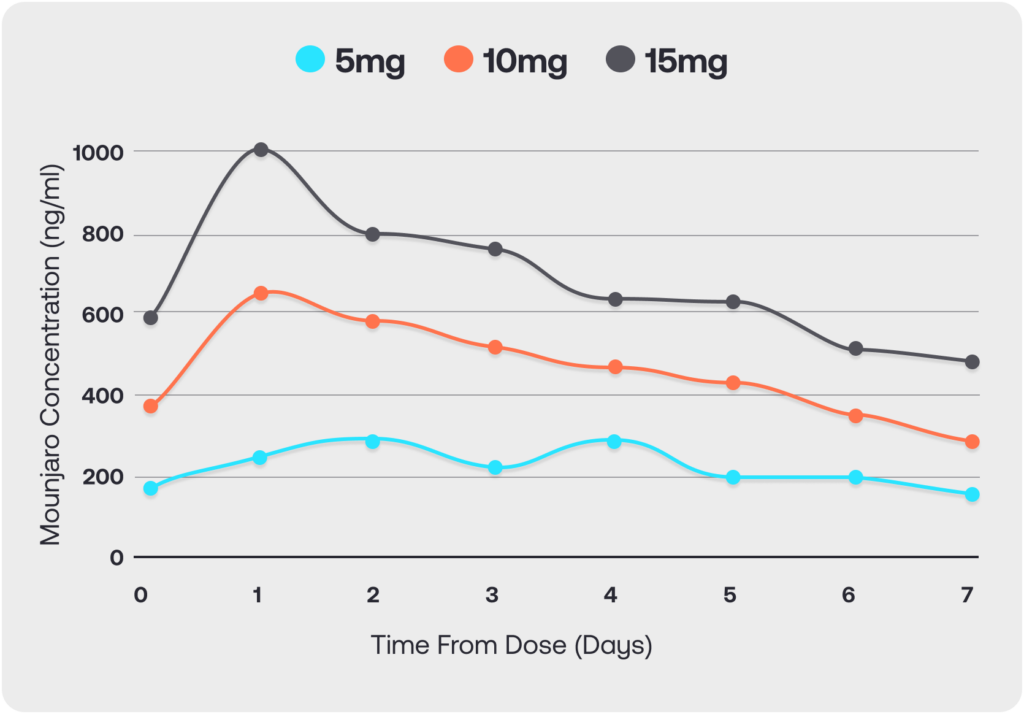
It really depends from person to person, but Mounjaro usually peaks in your body around 24 hours after you take it.
For some people, it might be as soon as 8 hours, or it could take up to 72 hours.

Once you take your Mounjaro shot, its active ingredient tirzepatide starts working by attaching to two targets called GLP-1 and GIP receptors. But you probably won’t feel the full effects right away, as it takes a bit of time for the medicine to build up in your system.
That said, some people do start noticing changes like a reduced appetite within just eight hours.
By around 24 hours, the medication usually reaches its peak level in your blood (although this depends on the dose you’re using and your weight).
This is when you might really start feeling it, especially in your appetite. You may feel fuller after eating smaller amounts of food because Mounjaro slows down how fast your stomach empties.
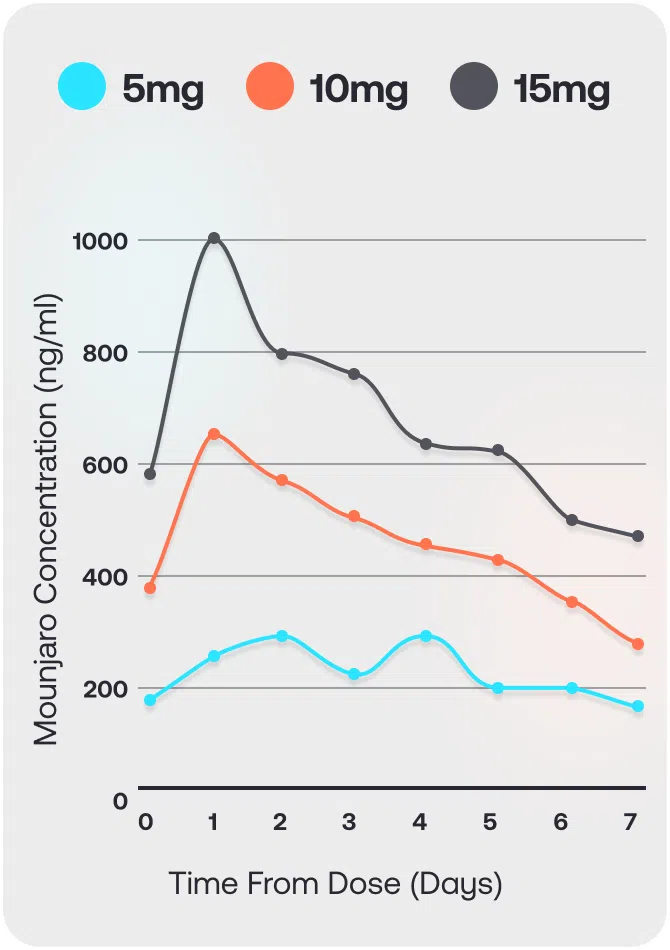
For most people, Mounjaro peaks on day 1 or 2.
This is when the effects are strongest. You’ll:
Mounjaro concentrations decrease slightly between days three to five, but the medicine remains fully active in your system.
Effects like appetite suppression and slowed digestion continue, and stay close to the maximum effects.
Blood sugar effects and insulin function remain stabilised.
By days five to seven, Mounjaro levels continue to decrease, but the medication is still active enough to keep working. You might notice you’re a bit hungrier during these days.
Mounjaro’s half-life is around 5 days. (Half-life is the amount of time it takes for the level of a medication in your body to drop by half. So after five days, only half of the dose is still active in your body.)
Because its effects start to gradually wear off after this time, this half-life supports a weekly injection schedule.
After about four weeks of regular use, your body reaches something called steady state. This is when the amount of a drug going into your body equals the amount being cleared out.
So after the first four weeks, the effects of Mounjaro remain largely constant, without big ups and downs in how the medication works. Which is why, in order to allow your body to adjust, doctors typically recommend increasing the dose every four weeks.
After taking a dose of Mounjaro, it can stay in your system for about 30 days. That’s because it has a half-life cycle of around five days. And it usually takes five to six of these cycles (so around 25–30 days) for a medication to leave your body.
But if you’re planning to get pregnant, it’s best to wait at least two months after your last injection before trying. That’s because the drug could still be in your system, and it’s not fully known how Mounjaro (tirzepatide) might affect a baby during pregnancy.
The exact amount of time Mounjaro stays in your body can vary depending on a few things:
So while 30 days is a good estimate, it’s going to be a bit different for everyone.
And if you’re stopping Mounjaro for a specific reason (like pregnancy), it’s always a good idea to talk it through with your doctor.
You’re most likely to feel Mounjaro side effects like nausea, vomiting, low blood sugar, diarrhoea, or constipation when you first start Mounjaro or when your dose goes up. That’s because your body is adjusting to higher levels of the medication.
Clinical Lead Dr Daniel Atkinson explains:
“I often remind patients that side effects from weight loss jabs like Mounjaro can feel more intense if you’re dehydrated or have just eaten a large meal. Since the medication slows down how quickly your stomach empties, being too full can make you feel bloated or nauseous. Staying well-hydrated and eating smaller, balanced meals can really help reduce these effects, especially when you’re just starting or increasing your dose.”
Wegovy and Mounjaro are two of the most talked-about weight loss treatments right now, but they work a little differently.
That’s because they contain different active ingredients: Wegovy uses semaglutide, while Mounjaro contains tirzepatide. And because of this, the time when Wegovy peaks in your body may be different.
How quickly each injection kicks in and how long the effects last can play a big role in choosing the right option for you. So if you’re weighing up your options, it helps to understand how they compare.
How we source info.
When we present you with stats, data, opinion or a consensus, we’ll tell you where this came from. And we’ll only present data as clinically reliable if it’s come from a reputable source, such as a state or government-funded health body, a peer-reviewed medical journal, or a recognised analytics or data body. Read more in our editorial policy.
MOUNJARO- tirzepatide injection, solution.
Population pharmacokinetics of the GIP/GLP receptor agonist tirzepatide. CPT Pharmacometrics & Systems Pharmacology, 13(3), pp.494–503.
How long will Mounjaro® (tirzepatide) be in the body after the last dose?
Have a subject you’d like us to cover in a future article? Let us know.
We're making healthcare more about you. Sign up to our newsletter for personalised health articles that make a difference.
Disclaimer: The information provided on this page is not a substitute for professional medical advice, diagnosis, or treatment. If you have any questions or concerns about your health, please talk to a doctor.
We couldn't find what you're looking for.
Here's everything we treat. Or, if you're looking for something we don't have yet, you can suggest something.
By clicking 'Subscribe now' you're agreeing to our Privacy Policy.
(And leave your email too, so we can let you know if we write an article based on your suggestion.)
Last updated on Jun 18, 2025.
Our experts continually monitor new findings in health and medicine, and we update our articles when new info becomes available.
Jun 18, 2025
Published by: The Treated Content Team. Medically reviewed by: Mr Craig Marsh, Independent PrescriberHow we source info.
When we present you with stats, data, opinion or a consensus, we’ll tell you where this came from. And we’ll only present data as clinically reliable if it’s come from a reputable source, such as a state or government-funded health body, a peer-reviewed medical journal, or a recognised analytics or data body. Read more in our editorial policy.