VerifiedFact Checked
Should I still use my blue inhaler?

Should I still use my blue inhaler?

New guidance from the British Thoracic Society (BTS), National Institute for Health and Care Excellence (NICE), and Scottish Intercollegiate Guidelines Network (SIGN) has changed how clinicians prescribe for asthma in the UK.

What this means for your treatment is that if you currently use a blue or brown inhaler (or both), the next time you have an asthma review, you might be recommended a different treatment. This is to better control your asthma and reduce the risk of flare-ups.

Craig Marsh
Medically reviewed by
Craig Marsh, Independent Prescriber
Go to
Reviewed on Jun 05, 2026. by Mr Craig Marsh Independent Prescriber Registered with GPhC (No. 2070724) Next review due on Jun 05, 2029.
Craig

Last updated on Jun 16, 2026.

Was this article useful?

How has asthma treatment guidance changed?

The latest UK guidance introduces the use of as-needed anti-inflammatory reliever (AIR) therapy as the first choice for people with newly diagnosed asthma aged 12 and over.

So, what’s different?

In the past, treatment often started with short-acting beta agonists (SABAs), typically blue, used to quickly relieve symptoms. But research has shown that overusing these blue inhalers can actually increase the risk of severe asthma attacks.

With AIR therapy, you use your inhaler when your asthma flares up or when you’re about to encounter a known trigger, such as exercise or allergens, to help prevent symptoms.

If AIR therapy isn’t enough to control your symptoms and you find yourself needing your inhaler three times or more in a week, the next step is usually maintenance and reliever therapy (MART). This is typically recommended for people with moderate to more persistent asthma.

MART uses a combination inhaler (usually ICS/formoterol), which has been shown to reduce the risk of asthma attacks.

With MART:

  • You take your inhaler every day to keep inflammation under control
  • You can also use the same inhaler for relief when symptoms flare up

So instead of using both a brown inhaler (preventer) and a blue inhaler (reliever), you have one inhaler to do both jobs. Much simpler.

Bottom line: Asthma management is shifting from ‘relieve only’ and ‘prevent only’ treatment towards treating both symptoms and the underlying inflammation with a single inhaler. This helps keep your symptoms under better control, reduces the risk of asthma attacks, and also makes treatment simpler and more convenient to use.

What is AIR therapy?

As-needed anti-inflammatory reliever (AIR) therapy is a modern approach to asthma treatment that combines quick relief with ongoing inflammation control.

What it means is to use your inhaler when you’re experiencing symptoms like:

  • wheezing (a whistling sound when breathing),
  • coughing,
  • shortness of breath, or:
  • chest tightness.

You can also use it before known triggers, like exercise or allergens.

AIR inhalers contain two active ingredients:

  • An inhaled corticosteroid (ICS), which reduces inflammation in your airways, helping prevent flare-ups.
    • Formoterol, a long-acting beta-agonist (LABA) that relaxes the muscles around your airways. It starts working quickly (within 1–3 minutes) and is still significant 12 hours after inhalation.

In the UK, inhalers licensed for AIR and MART therapy in patients aged 12 and over include:

  • Symbicort Turbohaler (budesonide + formoterol) – the 200/6 strength licensed for both AIR and MART, while the 100/6 strength is only licensed for MART,
  • Fobumix (budesonide + formoterol) – the 160/4.5 strength licensed for both AIR and MART, while the 80/4.5 strength is only licensed for MART,
  • DuoResp Spiromax (budesonide + formoterol) – the 160/4.5 strength licensed for both AIR and MART,
  • Fostair (beclometasone + formoterol) – the 100/6 strength is licensed for MART (not AIR); none of the strengths available are licensed for both AIR and MART, however,
  • Luforbec (beclometasone + formoterol) – the 100/6 strength is licensed for MART (not AIR), with none of the strengths available licensed for both AIR and MART.

Other combination inhalers can sometimes be used off-label for this purpose, but aren’t licensed for AIR/MART yet, including:

  • Formoterol combinations: Flutiform,
  • Other LABA combinations: Stalpex, Sirdupla, Sereflo, Fusacomb, Seretide, AirFluSal, Relvar Ellipta, and Combisal.

That said, licensing is updated regularly, so the options available can change over time.

What is MART therapy?

Maintenance and reliever therapy (MART) is a treatment approach for people with moderate to more persistent asthma. It uses a single inhaler for both daily maintenance and symptom relief, making treatment easier and more convenient, while improving asthma control.

MART inhalers are basically the same as the ones listed above for AIR therapy. The difference is in how you use the inhaler:

  • AIR therapy: used only when symptoms appear or before known triggers. Typical use: one puff when symptoms start, then another after a few minutes if needed.
  • MART therapy: used every day to control inflammation, and used as needed for relief of breakthrough symptoms. Typical use: one or two puffs twice daily, morning and evening.

You might be recommended MART if:

  • Your asthma isn’t well controlled with as-needed AIR therapy
  • You need your inhaler more than three times per week for symptom relief
  • You have moderate to severe asthma, where daily management is essential to reduce the risk of attacks

Are reliever (blue) inhalers still used?

The short answer is yes, but much less than before. And it’s expected that the use of blue inhalers will be phased out in the future.

Under the latest guidance, blue inhalers (short-acting beta agonists, or SABAs) are no longer recommended on their own for asthma. This is because they work by quickly opening up your airways, which is great for fast relief. But they don’t treat the underlying inflammation that causes asthma in the first place.

Over time, this can lead to poorer asthma control and a higher risk of severe asthma attacks, especially if the inhaler is used frequently.

That’s why newer approaches like AIR therapy are preferred. They treat both the symptoms (like breathlessness) and the inflammation at the same time.

So, do blue inhalers still have a role in asthma therapy? Yes, in some situations, for example:

  • If you’re still on a previous treatment plan and haven’t switched yet
  • While waiting for a review or transition to AIR or MART
  • For specific trigger situations (e.g. before intense exercise), depending on your clinician’s advice
  • When combination inhalers aren’t suitable or tolerated

Who should use preventer (brown) inhalers?

Preventer (brown) inhalers, which are single-ingredient corticosteroid inhalers, have traditionally been a key part of asthma treatment. But with the move toward AIR and MART, their role is changing.

If you’re using AIR or MART therapy, it’s unlikely you’ll also be prescribed a separate preventer inhaler. That’s because AIR and MART inhalers already contain a steroid component, so you’re getting inflammation control built into your main inhaler.

That said, you might still be prescribed a preventer inhaler if:

  • You’re still using a blue inhaler
  • You haven’t yet switched to AIR or MART
  • Your clinician is gradually switching you to a new treatment plan
  • If your asthma is well controlled with your current preventer

So while preventer-only inhalers may become less common, they’re still relevant in certain situations.

Who should use preventer (brown) inhalers?

Preventer (brown) inhalers, which are single-ingredient corticosteroid inhalers, have traditionally been a key part of asthma treatment. But with the move toward AIR and MART, their role is changing.

If you’re using AIR or MART therapy, it’s unlikely you’ll also be prescribed a separate preventer inhaler. That’s because AIR and MART inhalers already contain a steroid component, so you’re getting inflammation control built into your main inhaler.

That said, you might still be prescribed a preventer inhaler if:

  • You’re still using a blue inhaler
  • You haven’t yet switched to AIR or MART
  • Your clinician is gradually switching you to a new treatment plan
  • If your asthma is well controlled with your current preventer

So while preventer-only inhalers may become less common, they’re still relevant in certain situations.

Which type of inhaler should I use?

This depends on how often you get symptoms and how well your asthma is controlled. But, generally speaking:

  • Occasional symptoms: the recommended treatment is as-needed AIR therapy
  • Frequent symptoms or poor control with as-needed AIR therapy: typical recommendation is MART (daily use and as-needed)
  • More complex or severe asthma: seek specialist care
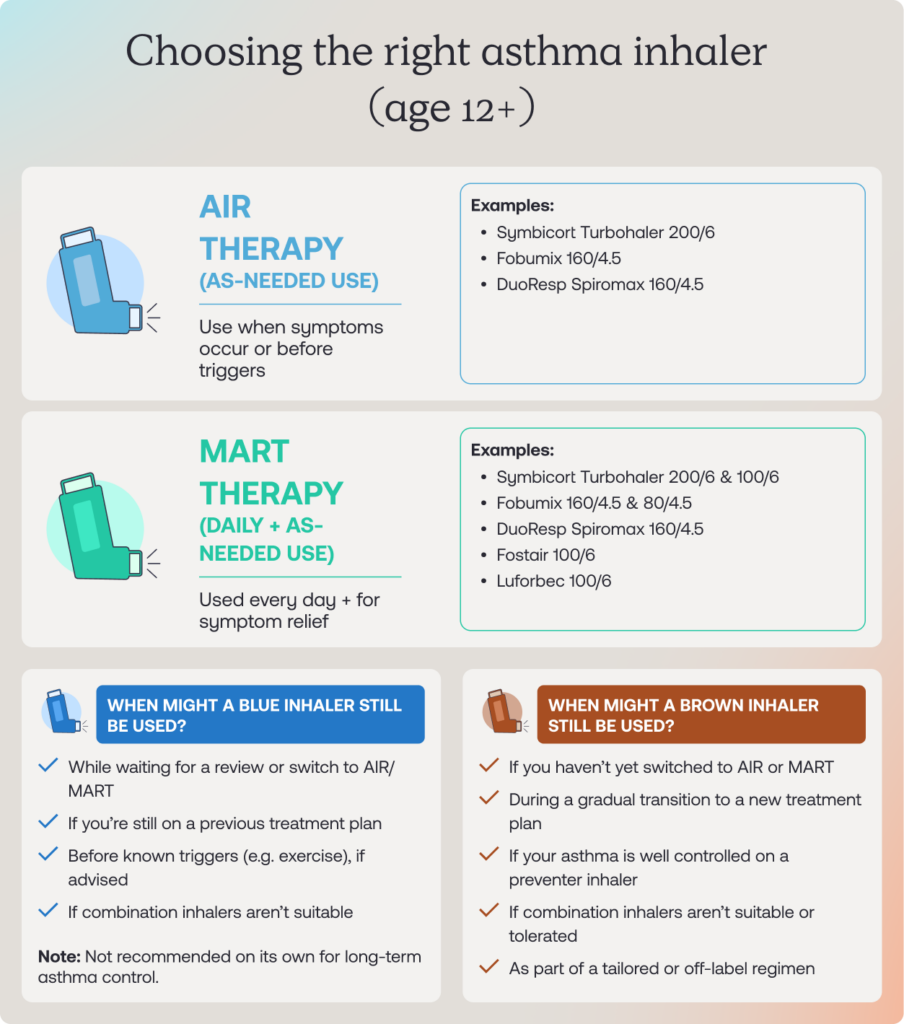
CHOOSING THE RIGHT ASTHMA INHALER (AGE 12+) AIR THERAPY (AS-NEEDED USE) Use when symptoms occur or before triggers Examples: Symbicort Turbohaler 200/6 Fobumix 160/4.5 DuoResp Spiromax 160/4.5 MART THERAPY (DAILY + AS-NEEDED USE) Used every day + for symptom relief Examples: Symbicort Turbohaler 200/6 & 100/6 Fobumix 160/4.5 & 80/4.5 DuoResp Spiromax 160/4.5 Fostair 100/6 Luforbec 100/6 WHEN MIGHT A BLUE INHALER STILL BE USED? While waiting for a review or switch to AIR/MART If you’re still on a previous treatment plan Before known triggers (e.g. exercise), if advised If combination inhalers aren’t suitable Note: Not recommended on its own for long-term asthma control. WHEN MIGHT A BROWN INHALER STILL BE USED? If you haven’t yet switched to AIR or MART During a gradual transition to a new treatment plan If your asthma is well controlled on a preventer inhaler If combination inhalers aren’t suitable or tolerated As part of a tailored or off-label regimen
CHOOSING THE RIGHT ASTHMA INHALER (AGE 12+)

Will a higher dose cause more side effects?

Not necessarily. The side effects reported in clinical trials for Wegovy 7.2mg were mostly the same as those reported with lower doses. And as long as the treatment progression is done correctly, under the supervision of your clinician, you’re likely to experience side effects similar to those you had with previous dose increases (or possibly none whatsoever).

In clinical trials, the most commonly reported side effects were gastrointestinal issues like nausea, vomiting, diarrhoea, and constipation. And although they were more frequently reported for the new 7.2mg dose, the difference was relatively small compared to the 2.4mg dose (71% versus 61%).

Another side effect that was more common for the 7.2mg dose was dysaesthesia, a condition causing burning, tingling, or otherwise unpleasant or painful sensations, due to nerve damage. But this time, the difference between the 7.2mg and the 2.4mg dose was more substantial (23% versus 6%). It’s not yet known why this happens, but, as unpleasant as it is, dysaesthesia doesn’t seem to affect your health. It can resolve on its own after a few weeks or months, and it goes away after stopping the treatment.

You’ll find more info on the frequency of these side effects for Wegovy 7.2mg, compared to the 2.4mg dose and the placebo in the table below.

But no matter what the clinical trials report, your experience with the medication can be extremely different. If the dose increase doesn’t sit well with you, it’s important to communicate this to your clinician so that they might recommend the best way forward. Often, this will involve reducing the dose or switching to another weight loss treatment.

Side effect/ outcome Wegovy 7.2mg Wegovy 2.4mg Placebo Notes on severity/ outcome Gastrointestinal side effects (nausea, vomiting, diarrhoea, constipation) 71% 61% 43% Mostly mild to moderate intensity Dysaesthesia (unpleasant or painful sensations because of nerve damage) 23% 6% 0.5% Mostly mild; most patients recovered while continuing treatment Serious side effects 7% 11% 5.5% Rare Stopping treatment due to side effects 5% 4% 1% In real life, if a higher dose isn’t well tolerated, clinicians typically recommend lowering the dose so that the patients can continue with their treatment
Treatment Active ingredient Effectiveness (percentage of baseline body weight lost) Wegovy 7.2mg Semaglutide -18.7% over 72 weeks[1] Wegovy 2.4mg Semaglutide -15.6% over 72 weeks[1] Mounjaro 15mg Tirzepatide -20.9% over 72 weeks[2] Mounjaro 10mg Tirzepatide -19.5% over 72 weeks[2] Mounjaro 5mg Tirzepatide -15.0% over 72 weeks[2] Saxenda Liraglutide -8% over 56 weeks[3] Xenical Orlistat -8.8% over 52 weeks[4]

When should I change my treatment?

If you’re currently using a blue inhaler (especially on its own), it’s worth having a conversation with your clinician at your next asthma review about whether you’re on the most up-to-date treatment and whether AIR or MART therapy would be suitable for you.

One important thing to remember: don’t stop your current treatment on your own. Even if you’re only using a blue inhaler, it’s important to:

  • Continue using it as prescribed
  • Speak to a clinician before making any changes
  • Follow your personalised asthma action plan

Switching treatment should always be done under a clinician’s supervision to keep you safe, and to ensure your asthma stays well-controlled throughout the process.

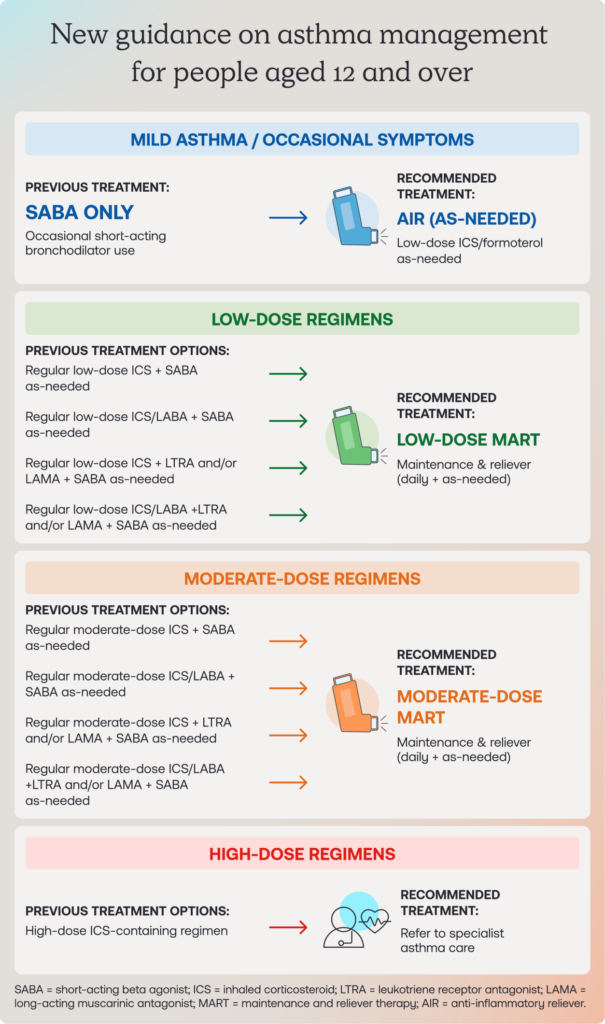
Depending on which treatment you’re currently using for asthma, your clinician might switch you to AIR or MART therapy, according to the current scheme:

NEW GUIDANCE ON ASTHMA MANAGEMENT FOR PEOPLE AGED 12 AND OVER MILD ASTHMA/ OCCASIONAL SYMPTOMS PREVIOUS TREATMENT vs. RECOMMENDED TREATMENT. SABA = short-acting beta agonist; ICS = inhaled corticosteroid; LTRA = leukotriene receptor antagonist; LAMA = long-acting muscarinic antagonist; MART = maintenance and reliever therapy; AIR = anti-inflammatory reliever
NEW GUIDANCE ON ASTHMA MANAGEMENT FOR PEOPLE AGED 12 AND OVER SABA = short-acting beta agonist; ICS = inhaled corticosteroid; LTRA = leukotriene receptor antagonist; LAMA = long-acting muscarinic antagonist; MART = maintenance and reliever therapy; AIR = anti-inflammatory reliever
Asthma
Asthma
Wondering what asthma treatment is right for you?

If you want to find out what asthma treatment options are suitable for you, our clinical team can offer personalised advice and support to help you choose the right treatment plan.

Reference Popover #ref1
Reference Popover #ref2
Reference Popover #ref3
Reference Popover #ref4
Reference Popover #ref5

How we source info.

When we present you with stats, data, opinion or a consensus, we’ll tell you where this came from. And we’ll only present data as clinically reliable if it’s come from a reputable source, such as a state or government-funded health body, a peer-reviewed medical journal, or a recognised analytics or data body. Read more in our editorial policy.

Tell us what you want to hear.

Have a subject you’d like us to cover in a future article? Let us know.

Give us the inbox treatment.

We're making healthcare more about you. Sign up to our newsletter for personalised health articles that make a difference.

Disclaimer: The information provided on this page is not a substitute for professional medical advice, diagnosis, or treatment. If you have any questions or concerns about your health, please talk to a doctor.