Home | Blog | Weight Loss | How Are Weight Loss Injections Kept Cool During Shipping?
Weight loss injections like Wegovy and Mounjaro need to be kept refrigerated to be safe and effective to use. So how do we get your treatment delivered to you at the right temperature?

Where possible, we’ll send orders through couriers with refrigerated vans. This means the entire cargo bay of the van is kept cool, so your medicine stays at the right temperature on its way to you.
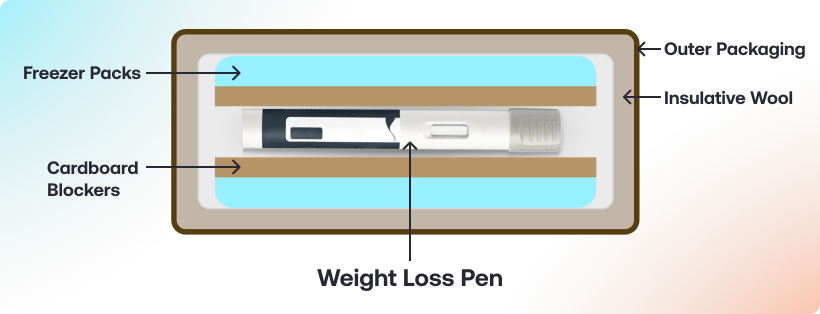
In other cases, there are three ways we keep your medication cool in transit. We’ll send your treatment in a package lined with insulative wool, and include ice packs along with your medication. This ensures your medicine leaves our pharmacy cold, and stays cold while travelling. There will also be two cardboard ‘blockers’ between your ice packs and medicine, to make sure it doesn’t get too cold or soggy as the ice packs start to thaw.
We’ll also send it via 24-hour tracked delivery, so it’s really unlikely the ice packs will melt before it arrives at your door. And you’ll know where your treatment is every step of the way.
If your treatment is sent in an unrefrigerated van, we’ll package it in a way that ensures it stays cool on the way to you.
We use a 24-hour tracked delivery service to send weight loss treatment, so it shouldn’t take any longer than this to arrive. This means the ice packs will stay frozen on their way to you, and your treatment will stay cold. We won’t send your treatment between Friday and Sunday, to make sure it’s not held at the delivery depot on a Sunday.
Wool is a really good insulator. The fibres it’s made up of create millions of tiny pockets of air that help trap heat and slow its spread through the material. This creates a barrier that helps keep heat out and cold in.
We make sure the wool we use is eco-friendly, sustainable, and biodegradable. It’s sourced from Woolcool®. Wool is an alternative insulation material to polystyrene or polyethylene foam that won’t sit in landfill after use. It’s completely compostable and is broken down by seawater much faster than manmade fibres – so no matter where it ends up, it’s safer for the environment.
As soon as you receive your package, put your pen(s) straight into the fridge. Put the patient information leaflets and wipes somewhere safe that you’ll remember when you need them. Then, it’s time to dispose of the packaging.
The wool we use is 100% biodegradable. That means you can put it in a compost heap, and it’ll break down naturally. If you don’t have a way to do this yourself, you can remove the wool from its plastic sleeve, break it down, and throw it into your garden waste bin to be collected.
You could also reuse your wool. It’s perfect for filling cushions, stuffed toys or pet beds; reupholstering furniture; lining hanging baskets; or as insulation. If you don’t have a use for it, someone else might. Try donating it to a local pet shelter, textile recycler, or craft group.
If you can’t reuse or recycle your wool insulation, you’re returning five or more liners, and you’re in the mainland UK, you can also use Woolcool®’s return scheme for free.
The plastic can be recycled in the same way you would plastic bags: in your household recycling bin if they’re accepted, or at a carrier bag recycling point. Check with your local council for plastic bag recycling guidelines in your area.
Leave your ice packs out to defrost fully, and then dispose of the gel in your general waste bin. The plastic can be recycled following your local council’s guidelines – either in your household recycling, or at a local recycling point.
How we source info.
When we present you with stats, data, opinion or a consensus, we’ll tell you where this came from. And we’ll only present data as clinically reliable if it’s come from a reputable source, such as a state or government-funded health body, a peer-reviewed medical journal, or a recognised analytics or data body. Read more in our editorial policy.
Have a subject you’d like us to cover in a future article? Let us know.
We're making healthcare more about you. Sign up to our newsletter for personalised health articles that make a difference.
Disclaimer: The information provided on this page is not a substitute for professional medical advice, diagnosis, or treatment. If you have any questions or concerns about your health, please talk to a doctor.
We couldn't find what you're looking for.
Here's everything we treat. Or, if you're looking for something we don't have yet, you can suggest something.
By clicking 'Subscribe now' you're agreeing to our Privacy Policy.
(And leave your email too, so we can let you know if we write an article based on your suggestion.)
Last updated on Jan 22, 2026.
Our experts continually monitor new findings in health and medicine, and we update our articles when new info becomes available.
Jan 22, 2026
Published by: The Treated Content Team. Medically reviewed by: Dr Alexandra Cristina Cowell, Writer & Clinical Content ReviewerHow we source info.
When we present you with stats, data, opinion or a consensus, we’ll tell you where this came from. And we’ll only present data as clinically reliable if it’s come from a reputable source, such as a state or government-funded health body, a peer-reviewed medical journal, or a recognised analytics or data body. Read more in our editorial policy.