Home | Blog | General health | Weight Loss | Is the new Wegovy pill more effective than other GLP-1s?

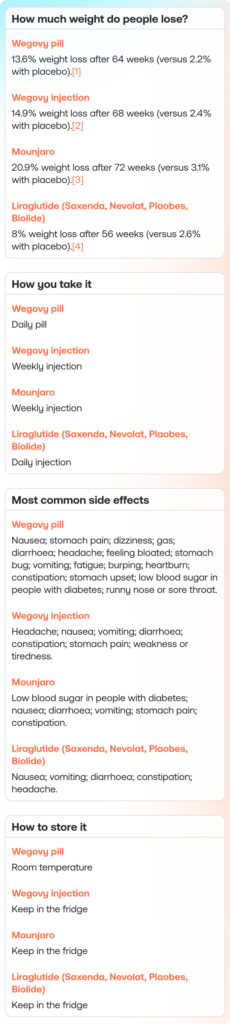
Yes and no. While the new Wegovy pill is more effective for weight loss than the only other oral GLP-1 medication available (Rybelsus, licensed only for type 2 diabetes), it’s less effective than some of the existing injection treatments available.

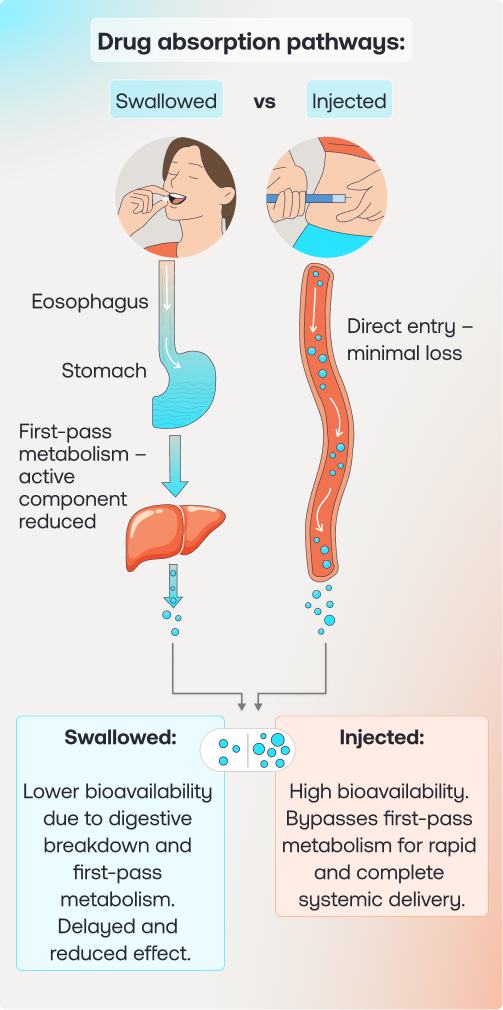
This is because injection treatments deliver the medication straight into your bloodstream, whereas oral medications need to be broken down in your digestive system. This often means that when you use an injectable medication, more of the drug circulates through your body, making it a more effective ‘pound for pound’ medication.
If you’re specifically looking to use a pill (and not an injection), then yes, oral Wegovy will be the most effective option for you. Let’s see how it stacks up against other weight loss pills:
There’s also another weight loss pill being developed called Orforglipron. Like oral Wegovy, Orforglipron is also a once-daily GLP-1 agonist, but unlike Wegovy, which is protein-based, it’s a non-peptide medication. This difference in chemical structure means Orforglipron is more easily absorbed in the body. So while oral semaglutide (the existing Rybelsus pill and upcoming Wegovy pill) needs to be taken on an empty stomach with a small, specific amount of water, Orforglipron will likely be licensed to be taken at any time of day, with or without food.
In terms of weight loss results, clinical trial participants taking Orforglipron lost an average of 11.2% of their body weight over 72 weeks, versus 13.6% average weight loss after 64 weeks with the Wegovy pill. So based on this existing data, the Wegovy pill might be slightly more effective than Orforglipron.
So to sum up:
In short, because more of the drug is able to enter your bloodstream when you inject it versus when you swallow it. When you take a pill, your body has to work harder to use it. It travels through your stomach and liver first, which breaks down some of the medication before it even reaches your blood. Because injection treatments bypass your digestive system and liver, you don’t need to inject as much of them to get the same effect.
With any systemic drug, the goal is for it to enter the bloodstream so it can influence how your body functions and behaves. And there are many different ways to do this, such as:
Each of these methods affects how much of the drug enters your blood, how quickly it’s absorbed, and what kind of side effects you might get. So when you swallow a pill, for example, it often takes a short while to enter your bloodstream (since you need to wait for your digestive system to break it down and process it). Whereas when a treatment is injected, it bypasses this, making its effect much more immediate and leaving more of the drug intact.
However, there are potential drawbacks with injectable medications that you don’t get with certain other methods. These include:
On the other hand, taking a pill can cause digestive side effects like acid reflux or nausea, and patches come with a risk of falling off or causing irritation.
As a result of all this, pharmaceutical companies try to develop medicines that will benefit you in the most suitable way all-round, including cost, ease of use, safety, and how best to treat your specific condition.
So while Wegovy pills need to be taken more often than injections to get the same effect, they can also be cheaper to produce, easier to use, and well-suited for those who don’t like needles.
Take it first thing in the morning, on an empty stomach, with a small amount of water (around 100ml). You should then wait at least 30 minutes before having any food or drink, or taking any other oral medications.
You should also swallow your pill whole (don’t crush or chew it).
Oral Semaglutide at a Dose of 25 mg in Adults with Overweight or Obesity. New England Journal of Medicine, 393(11), pp.1077–1087.
Randomised placebo-controlled trial of orlistat for weight loss and prevention of weight regain in obese patients. European Multicentre Orlistat Study Group. Lancet (London, England), 352(9123), pp.167–172.
Method-of-use study of naltrexone sustained release (SR)/bupropion SR on body weight in individuals with obesity. Obesity, 25(2), pp.338–345.
Orforglipron, an Oral Small-Molecule GLP-1 Receptor Agonist for Obesity Treatment. New England Journal of Medicine.
Once-Weekly Semaglutide in Adults with Overweight or Obesity. The New England Journal of Medicine, 384(11), pp.989–1002.
Tirzepatide Once Weekly for the Treatment of Obesity. New England Journal of Medicine, 387(3), pp.205–216.
A Randomized, Controlled Trial of 3.0 mg of Liraglutide in Weight Management. New England Journal of Medicine, 373(1), pp.11–22.
How we source info.
When we present you with stats, data, opinion or a consensus, we’ll tell you where this came from. And we’ll only present data as clinically reliable if it’s come from a reputable source, such as a state or government-funded health body, a peer-reviewed medical journal, or a recognised analytics or data body. Read more in our editorial policy.
Have a subject you’d like us to cover in a future article? Let us know.
We're making healthcare more about you. Sign up to our newsletter for personalised health articles that make a difference.
Disclaimer: The information provided on this page is not a substitute for professional medical advice, diagnosis, or treatment. If you have any questions or concerns about your health, please talk to a doctor.
We couldn't find what you're looking for.
Here's everything we treat. Or, if you're looking for something we don't have yet, you can suggest something.
By clicking 'Subscribe now' you're agreeing to our Privacy Policy.
(And leave your email too, so we can let you know if we write an article based on your suggestion.)
Last updated on Mar 26, 2026.
Our experts continually monitor new findings in health and medicine, and we update our articles when new info becomes available.
Mar 26, 2026
Published by: The Treated Content Team. Medically reviewed by: Dr Alexandra Cristina Cowell, Writer & Clinical Content ReviewerHow we source info.
When we present you with stats, data, opinion or a consensus, we’ll tell you where this came from. And we’ll only present data as clinically reliable if it’s come from a reputable source, such as a state or government-funded health body, a peer-reviewed medical journal, or a recognised analytics or data body. Read more in our editorial policy.