Home | Blog | Weight Loss | What to expect during the first month of taking the Wegovy pill
With the recent approval of the Wegovy pill in the UK, the effects of GLP-1 injections will soon be accessible from pharmacies in tablet form. So you might be asking yourself what the shift to the pill will feel like for you.
If you’re new to weight loss treatment, the first month on the Wegovy pill will represent the beginning of a significant shift in your relationship with food. Find out what changes to expect in your appetite, cravings, and weight, as well as the most common side effects you might experience.

While starting a new weight loss medication can feel exciting, it’s important to know what you’re embarking on and set realistic expectations. During your first month on the Wegovy pill, your body will be adapting to semaglutide, its active ingredient, or to a new formulation if you’ve used Wegovy injections before switching to the pill.
Most people won’t experience dramatic weight loss. Instead, the first month is typically a period of adjustment, where appetite begins to change, eating habits start to shift, and any side effects become more manageable as your body gets used to the medication.
That said, if you’re taking the Wegovy pill to keep your weight stable after using weight loss injections, you can expect the pill to help you maintain your weight.
Like all GLP-1 medications, the Wegovy pill can cause side effects, particularly when you first start treatment or increase your dose.
Common and very common side effects of the Wegovy pill include:
The gastrointestinal side effects usually happen because semaglutide, the active ingredient in the Wegovy pill, slows stomach emptying and alters how your digestive system processes food. If you’ve been taking GLP-1 injections, you may still experience these (or other) side effects as your body adjusts to the new drug formulation.
For most people, though, symptoms are mild to moderate and improve as your body adapts to the new treatment. To help reduce the likelihood and severity of these side effects, your clinician will likely recommend that you start on a low dose and gradually increase it over several months.
The list above only includes the common side effects and is not a complete list. If you have any concerns regarding possible unwanted effects, it’s always a good idea to consult with your clinician or check the patient information leaflet that comes with your medication.
One of the first changes many people notice on Wegovy is that they experience hunger differently. They usually describe hunger as becoming more predictable and easier to manage.
Semaglutide mimics a natural hormone called glucagon-like peptide-1 (GLP-1), which is released after eating. This is a complex hormone found throughout the body that works to reduce hunger by acting on areas of the brain involved in appetite regulation, helping you feel fuller for longer, and decreasing food cravings.
Many people report that the Wegovy pill has helped them:
Because the Wegovy pill is taken every day, some people may find their appetite suppression fluctuates less throughout the week compared to a once-weekly injection. This may vary considerably from person to person, and there isn’t much research comparing day-to-day hunger levels between oral and injectable semaglutide available at the moment.
It’s also important to take into account that appetite suppression builds gradually. And it’s normal to feel hungrier during the first month with the pill, while taking a starter dose that’s designed to help your body adapt rather than to maximise weight loss.
Different people may use the Wegovy pill for different reasons. While some may use it right from the start of their weight loss journey, others may switch from jabs and use the pills to help maintain the weight they’ve already lost.
But no matter why you’re starting on the Wegovy pill, the first month is unlikely to produce the full effects reported in clinical trials because it’s very likely that your clinician will recommend that you begin treatment at a low dose. The usual dosing schedule starts at 1.5mg daily before gradually increasing to 4mg, 9mg, and eventually 25mg, with at least one month spent at each dose level.
Clinical studies show that the medication is much more effective at higher doses. In a trial, adults taking oral semaglutide at the 25mg dose (the highest dose used currently) achieved an average weight loss of 16.6% of their body weight after 64 weeks, compared with around 2% in the placebo group.
There isn’t a great deal of published data specifically examining average weight loss during the first month of treatment. However, weight loss with semaglutide typically follows a more gradual pattern, and continued use over several months, while following a dose escalation plan usually renders the greatest results.
For this reason, if you’re starting your weight loss journey with the pill version of Wegovy, it’s best to view the first month as the foundation for future weight loss rather than a period of dramatic change.
Here’s a quick guide on what ED medication may be best for you, depending on your lifestyle:
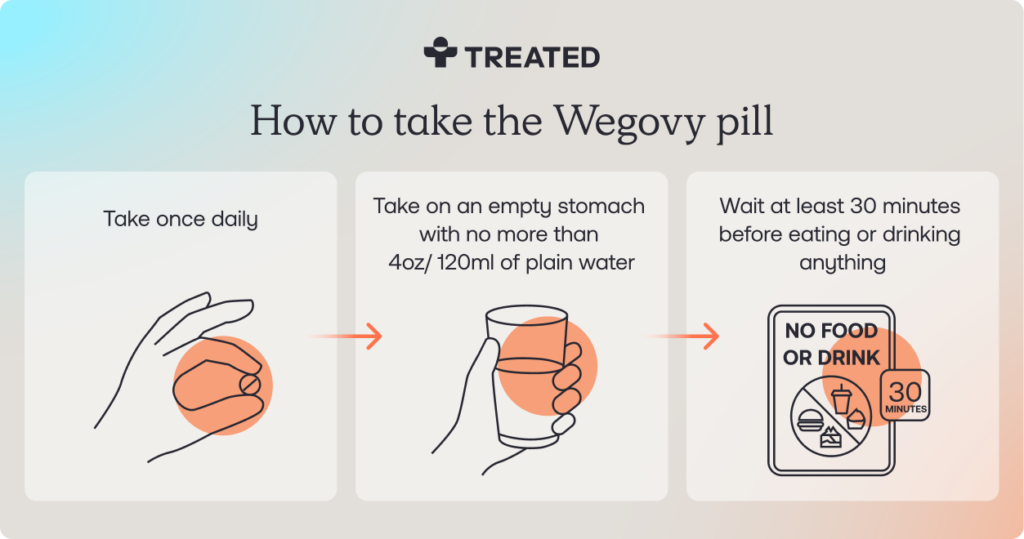
It’s essential to take the Wegovy pill correctly, because semaglutide is absorbed differently from many other medications. So, to get the best weight loss results, it’s important to take the following into account:
1. Fast for at least 8 hours before taking the tablet
You’ll need to take it on an empty stomach, having not eaten for the previous eight hours.
2. Take the tablet with a small amount of water
Swallow the tablet with 4oz or 120ml of plain water.
It’s important to stick to this limit, as taking it with a larger volume of water may dilute it within your stomach, reducing the amount of the medication absorbed by your body.
3. Wait at least 30 minutes before eating or drinking
After taking the pill, wait at least 30 minutes before consuming food, drinks or taking any other medications by mouth.
This is because if you eat or drink too soon after you’ve taken the pill, the amount of semaglutide absorbed by your body can be significantly reduced, making the medication much less effective.
4. Swallow the tablet whole
Do not crush, split, or chew the tablet.
The tablet is especially designed to protect the medication inside and help it be absorbed correctly into your body. Damaging the tablet by crushing or chewing it could interfere with how the medication is absorbed and, in turn, make it less effective.
Because you need to have fasted for at least eight hours beforehand, the best time to take the Wegovy pill is first thing in the morning on an empty stomach.
This is to allow the medication to be absorbed under the conditions it was tested and designed for, and to help ensure maximum effectiveness.
A simple routine is:
Taking the medication at the same time each day can also help you build a consistent habit and reduce the likelihood of missed doses.
Weight loss pills can help reverse small weight regains, and again, may feel less like a commitment than injections. So if you’re starting to notice signs like food noise, stronger cravings, or hunger returning, ask your clinician whether the weight loss pill could be a suitable option for you.
Here are some general rules you can follow to make sure your Wegovy pills are stored effectively:
Also, if you’ve got any tablets left in the package at the end of the treatment, it’s important not to throw them away with the rest of your household refuse or flush them down the toilet. Instead, take them to your local community pharmacy to be destroyed safely. Just make sure to keep them in their original packaging (so that the pharmacy staff will know what’s inside the pack and how best to destroy it) and to remove any personal information from prescription labels, if necessary.
Wegovy 25 mg tablets (Reference only - not currently marketed in the UK) - Patient Information Leaflet (PIL).
First GLP-1 tablet for weight loss approved in the UK.
Oral Semaglutide at a Dose of 25 mg in Adults with Overweight or Obesity. New England Journal of Medicine, 393(11), pp.1077–1087.
How we source info.
When we present you with stats, data, opinion or a consensus, we’ll tell you where this came from. And we’ll only present data as clinically reliable if it’s come from a reputable source, such as a state or government-funded health body, a peer-reviewed medical journal, or a recognised analytics or data body. Read more in our editorial policy.
Have a subject you’d like us to cover in a future article? Let us know.
We're making healthcare more about you. Sign up to our newsletter for personalised health articles that make a difference.
Disclaimer: The information provided on this page is not a substitute for professional medical advice, diagnosis, or treatment. If you have any questions or concerns about your health, please talk to a doctor.
We couldn't find what you're looking for.
Here's everything we treat. Or, if you're looking for something we don't have yet, you can suggest something.
By clicking 'Subscribe now' you're agreeing to our Privacy Policy.
(And leave your email too, so we can let you know if we write an article based on your suggestion.)
Last updated on Jun 30, 2026.
Our experts continually monitor new findings in health and medicine, and we update our articles when new info becomes available.
Jun 30, 2026
Published by: The Treated Content Team. Medically reviewed by: Mr Craig Marsh, Independent PrescriberHow we source info.
When we present you with stats, data, opinion or a consensus, we’ll tell you where this came from. And we’ll only present data as clinically reliable if it’s come from a reputable source, such as a state or government-funded health body, a peer-reviewed medical journal, or a recognised analytics or data body. Read more in our editorial policy.
Independent Prescriber

Craig is a pharmacist who’s also qualified to prescribe, which means he’s a bit of an expert on which medicines work best in any given situation. He consults with patients first hand, and also does a lot of work researching new and existing medications for the conditions we treat. Registered with the GPhC (No 2070724).
MeetHow we source info.
When we present you with stats, data, opinion or a consensus, we’ll tell you where this came from. And we’ll only present data as clinically reliable if it’s come from a reputable source, such as a state or government-funded health body, a peer-reviewed medical journal, or a recognised analytics or data body. Read more in our editorial policy.