Trusted Shops is a company that validates online merchants and offers buyer protection services.
They audit the processes companies use to trade online and provide a 'TrustMark' to those who meet their criteria of being price transparent, and offering quality customer service and data security.
Price checker
10mg
20mg
£34.95
28 Tablets £34.95
56 Tablets £51.95Save £17.95
84 Tablets £67.95Save £36.90
Prices include:
Express shipping
24 hour shipping by secure courier.
Consultation + Access to our clinicians
Ask our experts anything you like, any time you want.
Total
£34.95
Save £0.00 each order
Reviewed on Mar 19, 2026. byMr Craig MarshIndependent PrescriberRegistered with GPhC (No. 2070724)Next review due on March 19, 2029.
Last updated on Mar 19, 2026.
Product info
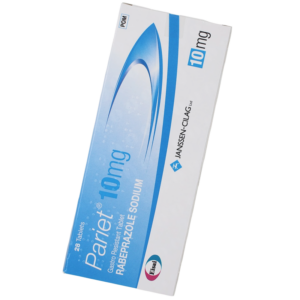
Pariet is a daily tablet that treats symptoms of gastro-oesophageal reflux disease (GORD).
It contains rabeprazole, a proton pump inhibitor that reduces stomach acid.
The tablets come in 10mg and 20mg strengths.
Price checker
10mg
20mg
£34.95
28 Tablets£34.95
56 Tablets£51.95Save £17.95
84 Tablets£67.95Save £36.90
Prices include:
Express shipping
24 hour shipping by secure courier.
Consultation + Access to our clinicians
Ask our experts anything you like, any time you want.
Pariet is a GORD treatment that belongs to a class of medicines known as proton pump inhibitors (PPIs). It contains the active ingredient rabeprazole, which decreases stomach acid production.
In the lining of your stomach you have proton pumps. They’re enzymes that produce acid, so you can break down food and easily digest it.[1] Proton pump inhibitors work by blocking an enzyme called the gastric H,K-ATPase, inhibiting the secretion of gastric acid.[2] Or put simply — they reduce the amount of stomach acid you make.
GORD occurs when this acid leaks into your oesophagus.[3] When this happens, it creates a range of unpleasant symptoms. Heartburn (a burning feeling in your chest, usually after meals), bad breath, bloating and difficulty swallowing are all commonly experienced by anyone with GORD. It can also give you acid reflux, where the acid from your stomach produces a sour taste in your mouth.
How do Pariet tablets work?
Stomach acid is required for normal, healthy digestion. If you suffer from GORD, it’s usually because you’re producing too much of it or it’s going to the wrong places. The excess acid seeps through the ring of muscle at the base of your oesophagus, and eventually enters your throat. PPIs (proton pump inhibitors) like Pariet are effective medications which are prescribed to stop this from happening. Doing so should ease heartburn, acid reflux, bloating and any other GORD-related symptoms you’re experiencing regularly.
There are two different strengths of Pariet (10mg and 20mg tablets) and they can be used for different lengths of time. PPIs counteract the problems caused by your body producing excessive amounts of stomach acid, and prevents it from leaking into your oesophagus.[4]
What doses does Pariet come in?
For the long-term management of GORD, you’ll take one 10mg or 20mg tablet a day, depending on the severity of your symptoms. The tablets should be taken each morning before eating.
If you have severe GORD, and it’s erosive or ulcerative, you’ll need the higher dose 20mg tablets. These are also taken once a day (each morning before eating) but can be taken for 4-8 weeks.
A clinician can also advise you on what dose of Pariet to take if you suffer from peptic or duodenal ulcers.
Shin, J.M. and Sachs, G. (2008). Pharmacology of proton pump inhibitors. Current Gastroenterology Reports, 10(6), pp.528–534.
NHS Inform (2019). Gastroesophageal Reflux Disease Symptoms and Conditions.
Harvard Health Publishing (2024). Proton-Pump Inhibitors.
This page was written by The Treated Content Team.
This page was medically reviewed by Mr Craig Marsh on March 19, 2026. Next review due on March 19, 2029.
How we source info.
When we present you with stats, data, opinion or a consensus, we’ll tell you where this came from. And we’ll only present data as clinically reliable if it’s come from a reputable source, such as a state or government-funded health body, a peer-reviewed medical journal, or a recognised analytics or data body. Read more in our editorial policy.
ParietRabeprazole sodium
How to take Pariet
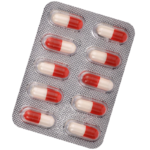
You should always follow the advice of your clinician when taking Pariet. Only remove a tablet from the blister pack when you’re about to take it.
Swallow your tablet whole, with a glass of water. A clinician will usually recommend you take Pariet first thing in the morning, before you’ve had any food. Taking the tablets at the same time each morning reduces your chances of missing a dose, or accidentally taking too much.
What if I make a mistake while taking Pariet?
If for any reason you take more Pariet than you need, talk to your doctor or go to hospital immediately. Bringing your medicine pack with you will mean you can get the right medical attention quicker.
If you forget to take a dose of Pariet, you can take one when you remember so long as it isn’t too close to the time of your next dose. As you only need one tablet a day (this applies to both the 10mg and 20mg strengths), there’s no need to double up your dose to make up for missing a tablet. Carry on with your usual routine and you should avoid taking too much.
You should never stop taking Pariet without speaking to a clinician first. If you forget to take your tablets for five consecutive days, get in touch with us before taking any more medication. Missing this amount could cause problems once you re-start, so it’s recommended you get expert advice before doing so.
This page was written by The Treated Content Team.
This page was medically reviewed by Mr Craig Marsh on March 19, 2026. Next review due on March 19, 2029.
How we source info.
When we present you with stats, data, opinion or a consensus, we’ll tell you where this came from. And we’ll only present data as clinically reliable if it’s come from a reputable source, such as a state or government-funded health body, a peer-reviewed medical journal, or a recognised analytics or data body. Read more in our editorial policy.
ParietRabeprazole sodium
Pariet isn’t suitable for everyone, and there are some things that you need to be aware of before you start using them.
Here’s all the official info on it. If anything is unclear, let our clinician know, and they can talk with you about it.
ParietRabeprazole sodium
FAQ: Pariet
Have something specific you want to know? Search our info below, or ask our experts a question if you can’t find what you’re looking for.
Are there any treatments similar to Pariet?
Answer:
There are a lot of options available when it comes to treating GORD. Lansoprazole and Pantoprazole are both PPIs, like Pariet. Pantoprazole is available in 20mg and 40mg tablets, and is a suitable choice if you’ve got liver problems.
Lansoprazole is available as a capsule, or as a tablet that melts on your tongue. Both of these medicines are generics, which might make them a cheaper option than branded GORD treatments.
Over-the-counter antacids are widely available, but are usually used for milder, one-off cases of acid reflux sometimes brought on by indigestion.
How effective is Pariet?
Answer:
PPIs have been proven to be effective for treating GORD. In studies comparing them with earlier medications like histamine2-receptor antagonists and anticholinergics, proton pump inhibitors demonstrated excellent safety, were well tolerated by patients, and showed a better capability of reducing acid production than other options.[1]
In one review of managing acid-related diseases that compared rabeprazole with other drugs, it was found to have faster acid inhibition than other similar medications.[2]
Is Pariet available over the counter?
Answer:
Some proton pump inhibitors are available over-the-counter, but you’ll need a prescription before you can start taking Pariet tablets daily. This is to ensure it’s safe for you to use regularly.
Can I take Pariet tablets if I’m pregnant or breastfeeding?
Answer:
You should avoid using Pariet if you're pregnant, or think you might be. It should also be avoided if you’re breastfeeding.
A clinician can advise you about the safest, most suitable options to manage persistent acid reflux symptoms in both of these instances.
Can Pariet be taken long-term?
Answer:
The 10mg Pariet tablets are usually prescribed for 4 weeks, and the 20mg a maximum of 8 weeks. If you think you’ll need to manage your GORD symptoms for any longer than this, we’ll let you know if it’s safe for you to continue using it long-term.
Taking rabeprazole for longer than 3 months can cause the magnesium levels in your blood to drop, and taking the tablets for more than 12 months can lead to bone fractures and gut infections. That doesn’t mean it won’t be safe for you to use, but a clinician will want to check in with you regularly to make sure the medication isn’t causing you any problems.
Published by: The Treated Content Team.Medically reviewed by: Dr Daniel Atkinson, GP Clinical Lead
How we source info.
When we present you with stats, data, opinion or a consensus, we’ll tell you where this came from. And we’ll only present data as clinically reliable if it’s come from a reputable source, such as a state or government-funded health body, a peer-reviewed medical journal, or a recognised analytics or data body. Read more in our editorial policy.
This is healthcare on your terms.
All from the comfort of your device. Get access to what you need, when you need it.
100% online
Ask questions and get expert recommendations, at the touch of a button.
Tailored choices
We'll narrow down some treatments for you to choose from based on your medical profile.
Express delivery
Receive your treatment by secure delivery, in discreet packaging.
Repeats made easy
Set your own delivery schedule and pause or make changes any time you like.
We're making healthcare more about you. Sign up to our newsletter for personalised health articles that make a difference.
Mr Craig Marsh
Independent Prescriber
Craig is a pharmacist who’s also qualified to prescribe, which means he’s a bit of an expert on which medicines work best in any given situation. He consults with patients first hand, and also does a lot of work researching new and existing medications for the conditions we treat. Registered with the GPhC (No 2070724).
When we present you with stats, data, opinion or a consensus, we’ll tell you where this came from. And we’ll only present data as clinically reliable if it’s come from a reputable source, such as a state or government-funded health body, a peer-reviewed medical journal, or a recognised analytics or data body. Read more in our editorial policy.
Reviews you can trust
All of our reviews are collected from real patients after their treatment has been delivered.
We publish reviews collected through independent platforms including Reviews.io and Trustpilot.