

ProductName

VerifiedFact Checked
Mounjaro Price Increases: What You Need to Know

Mounjaro Price Increases: What You Need to Know

Mounjaro is one of the most effective GLP-1 medications.

Following September 2025, Mounjaro now costs more to buy privately in the UK.

Craig Marsh
Medically reviewed by
Craig Marsh, Independent Prescriber
Go to
Medically reviewed by
Mr Craig Marsh
Independent Prescriber
on Sep 10, 2025.
Meet Craig  
Craig

Last updated on Sep 10, 2025.

Was this article useful?
1 people found this helpful
  • The price increase was due to UK supply prices being raised by its manufacturer, Eli Lilly.
  • All private providers in the UK have been affected by this change.
  • NHS patients receiving Mounjaro are not affected—their costs remain the same.

Here’s a guide with all the details on the price changes, what to do if you’re concerned about the increase, and what alternatives you have.

How much have Mounjaro prices increased by?

In September 2025, the manufacturer’s list price for a month’s supply of the highest Mounjaro dose (15mg) nearly tripled, rising by 170%. A list price is the official price a manufacturer sets for a medication. It’s like a reference price, but it doesn’t always mean that’s exactly what you pay out of pocket. Sometimes your provider adds services like consultations, delivery, or may apply certain discounts.

Lower doses will also be going up in price, but the increases will be less substantial.

And usually private healthcare providers, like pharmacies, will have to pass these increases on to their patients to cover their increased costs.

The final costs of the medication may vary between private providers based on what additional services they offer, like consultations, shipping, or aftercare.

Below is a summary of Treated prices for Mounjaro following this increase. These will take effect from the 20th September 2025.

Mounjaro dose (4-dose pen) New price Old price
2.5mg £279.95 £189.95
5mg £279.95 £189.95
7.5mg £379.95 £219.95
10mg £379.95 £219.95
12.5mg £449.95 £279.95
15mg £449.95 £279.95

The prices charged by Treated for Mounjaro include:

  • Consultation: You’ll have an online consultation with a qualified clinician who will check if Mounjaro is right for you.
  • Prescription: If Mounjaro is suitable for you, your prescription is included in the cost.
  • Next-day delivery: Secure shipping within one working day.
  • Dispensing the medication: Preparation of your Mounjaro pens at our UK pharmacy.
  • Personalised aftercare: Regular check-ins with your clinician to make sure your treatment is working safely and effectively.
  • Healthy lifestyle coaching: Diet, exercise, and lifestyle tips to help make your treatment more effective.

Why have Mounjaro prices increased?

There are many reasons behind this price increase, but you’ll find some of the most important ones summarised below.

Eli Lilly, the manufacturer behind Mounjaro, says that:

  • the price rise is to fix “pricing inconsistenciesbetween countries. The lower UK price was always meant to be temporary, set to give people earlier access. Now that more research is available and the drug is sold in more countries, they want UK prices to match global levels.
  • the pricing of current medications helps cover the cost of developing new treatments, which they say is key to driving future healthcare “innovation”.

UK versus the rest of the world:

  • The UK was one of the first countries where Mounjaro became available, and because of that, it was priced lower than in many other places. That’s been great news for patients, but it also meant that the manufacturer had to balance the medication’s affordability with the high costs of producing it worldwide.
  • This decision was also influenced by the wider global debate on Mounjaro’s costs, including discussions in the US about linking medication prices to what other countries pay.

What this means for private providers:

Because the wholesale cost of Mounjaro has increased, all legitimate private providers in the UK have been affected. This means that if you buy Mounjaro privately, whether through a clinic, pharmacy, or online provider, you’ll see higher prices, since providers need to pass on the increased supply costs.

What this means for NHS prices:

If you’re receiving Mounjaro through the NHS, however, this price change won’t affect you. NHS pricing and supply agreements are separate from the private market, so the cost to NHS patients will remain the same.

Could Mounjaro prices increase again?

It’s difficult to predict exactly when or if medication prices will rise again. There are lots of factors that can influence the cost of a drug, including:

  • Cost of ingredients and manufacturing: If it becomes more expensive to source or produce the components that make up Mounjaro.
  • High demand: When more people are prescribed the treatment, demand can put pressure on supply and affect prices.
  • Wider economic factors: Things like inflation, exchange rates, or global supply chain issues can also play a role.

Right now, we don’t expect Mounjaro prices to increase again in the short term. But it’s always a possibility if circumstances change. 

What are your options?

If you’re worried about the rising cost of Mounjaro, it’s important not to make any sudden changes to your treatment on your own. Stopping Mounjaro suddenly can cause you to regain weight, increase your appetite, and cause your blood sugar levels to increase, especially if you have type 2 diabetes.

So before deciding what to do next, take time to consider your options and speak with your clinician about the medical implications.

Your choices may depend on how close you are to meeting your weight loss goals:

If you’re still losing weight

If your BMI is between 25 and 35 and your weight is continuing to come down, your doctor may recommend staying on Mounjaro or adjusting your dose. Sometimes a lower dose can still give results, while also reducing costs.

If you’ve reached your target weight

If you were taking Mounjaro just to maintain your weight, you may not need to stay on the same dose long-term. Your doctor might suggest tapering down, switching to a lower, more affordable maintenance dose, or exploring alternative treatments.

Stay on Mounjaro

Should you decide to continue with Mounjaro, your treatment will now cost more, due to the price increase. Some private providers, though, offer discounts if you order packs or multiple pens at once, which can help reduce the cost.

In the long run, staying on Mounjaro may actually be more cost-effective. Switching to another treatment or taking a break can potentially slow your progress, as you may not get the same level of effectiveness. So it might take longer to reach your target weight.

If you’re buying Mounjaro privately, it’s worth contacting your provider. They can help you weigh the cost against the benefits and figure out the best approach forward.

Switch to Wegovy

But if the rising cost of Mounjaro is a concern, some people consider switching to Wegovy. Wegovy is, like Mounjaro, a weekly injection. And it works in a similar way in your body to help you lose weight, by decreasing your appetite so that you eat less.

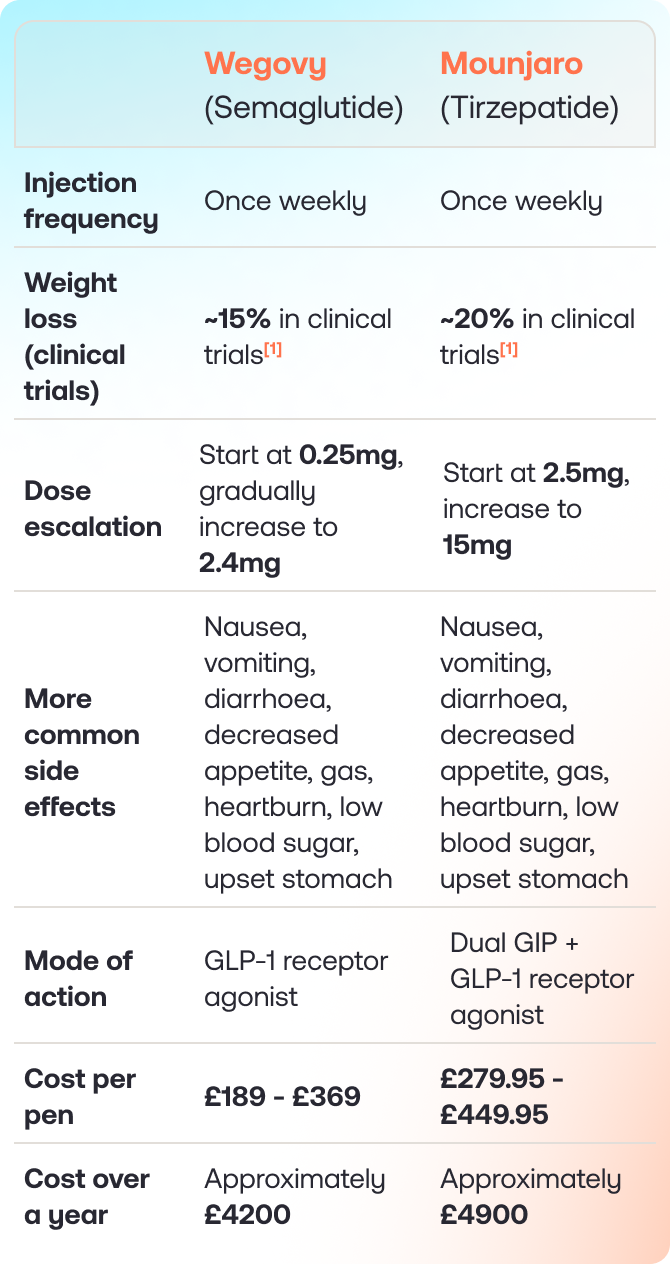
Pros:

  • Works in much the same way as Mounjaro, so the transition can be straightforward (no need for long breaks to let your body adjust to a new treatment).
  • Wegovy is already established as a safe treatment for most people and is widely used.
  • A new higher dose (7.2mg) has been trialled and may be available in the future, potentially offering results comparable to, or even better than, the highest dose of Mounjaro.

Cons:

  • It may not be quite as effective as Mounjaro for everyone, depending on your current dose and how your body responds.
  • As with any medication, you might experience some side effects. But since Wegovy works similarly to Mounjaro, the side effects are usually pretty similar too.
  • Switching could temporarily slow your weight loss as your body adjusts to the new treatment.

These pros and cons will vary person to person. And at the end of the day, whether Wegovy is a good option for you depends on your target weight, previous progress, and how you respond to treatment.

So it’s best to discuss the switch with your clinician to help you figure out if this is the right decision for you.

Which Wegovy dose to switch to

At the moment, there aren’t any standardised recommendations on which dose to switch to if you’re changing from Mounjaro to Wegovy.

But the clinical team at Treated have created switching guidance based on the research that’s currently available. Their recommendations are as follows.

If your most recent dose of Mounjaro was within the last two weeks, and the last Mounjaro dose you used was:

  • 2.5mg, change to the 0.25mg dose of Wegovy
  • 5mg, change to the 0.5mg dose of Wegovy
  • 7.5mg or 10mg, change to the 1mg dose of Wegovy
  • 12.5mg or 15mg, change to the 1.7mg dose of Wegovy

After four weeks of using Wegovy, you then have the option to progress through doses based on your response to the treatment.

If your most recent dose of Mounjaro was more than two weeks ago, but less than four weeks ago, and the last Mounjaro dose you used was:

  • 2.5mg or 5mg, change to the 0.25mg dose of Wegovy
  • 7.5mg or 10mg, change to the 0.5mg dose of Wegovy
  • 12.5mg or 15mg, change to the 1mg dose of Wegovy

Again, you’ve got the option to cycle up through Wegovy doses after four weeks, based on your individual response.

If it’s been more than four weeks since your last Mounjaro dose, it’s recommended to start again at the lowest dose of Wegovy (0.25mg).

In any event, you should always consult with your clinician before changing from Mounjaro to Wegovy (or vice versa). There may be considerations specific to your use of these medications and your response to them that may change their recommendation.

Read more in our guide about switching between weight loss treatments, which explains in more detail what your options are.

Switch to Saxenda or Nevolat

Another option for you is to switch to liraglutide, sold as Saxenda (branded original) or Nevolat (branded generic). Saxenda has had intermittent supply issues in the UK, but Nevolat (the generic) is available and may be easier to access.

Saxenda and Nevolat work in the same way, as they contain the same active ingredient (liraglutide). Liraglutide is another GLP-1 agonist, same as Wegovy and Mounajro, but is injected daily, as opposed to weekly.

Pros:

  • Daily routine suits some people: You might find that a set daily habit can feel more steady and predictable for you.
  • Established safety profile: Liraglutide has been around longer than Mounjaro, so its side effects are well studied.
  • Daily adjustments possible: Because it’s a daily injection, you may feel more in control and adjust your treatment more easily if you get side effects.
  • Cost: Nevolat (generic Saxenda) is typically more affordable than Mounjaro after the price increases.

Cons:

  • Daily injections: Require more consistency and can be harder to stick with long-term.
  • Effectiveness: Clinical trials show 6–7% weight loss on average with liraglutide vs 15–21% on average with tirzepatide.
  • Cost versus outcome: Even if per-pen prices are lower, overall value depends on your results; needing longer treatment to reach the same goals can offset the price.

Check your NHS eligibility

You can also consider getting Mounjaro through the NHS. But eligibility is usually limited to people with:

  • a BMI of 40 or more (adjusted for ethnicity)
  • and with multiple specific weight-related conditions like abnormal fat levels in your blood, high blood pressure, if your breathing stops and starts while you sleep (obstructive sleep apnoea), or if you have type 2 diabetes.

The process typically involves a referral from your GP, an assessment by a specialist, and ongoing monitoring while you’re on treatment. And depending on your location, it might also involve lengthy waiting lists.

And you might need to consider that if you’re already buying Mounjaro privately, you might not meet these criteria. But it’s still worth checking with your local integrated care board if you’re curious about your NHS options.

Stop treatment altogether

If you’ve reached your target weight (congratulations on your hard work), you’re on a maintenance dose, and are thinking about stopping Mounjaro, it’s important to taper off gradually rather than stopping treatment abruptly. Your clinician can guide you on how to reduce your dose safely.

And even after stopping, keeping up the healthy habits you’ve developed, like:

  • eating a balanced diet,
  • engaging in regular physical activity,
  • and practising mindful lifestyle choices, like following a healthy sleep routine, reducing alcohol intake, and managing stress levels

can help prevent your weight from creeping back up.

For more info on this, see our page on how to come off weight loss injections.

How can I avoid counterfeit Mounjaro?

When medication prices go up, it’s not uncommon for some counterfeiters to try and take advantage by selling fake or unsafe versions of medications.

If a deal seems too good to be true, it probably is. So it’s worth staying alert.

One thing you can do when buying Mounjaro online is to make sure that your provider is legitimate. Check that:

  • There’s a General Pharmaceutical Council (GPhC) voluntary internet pharmacy logo displayed on the pharmacy’s website
  • The prescribing clinicians are all registered in the UK with the General Medical Council (GMC), the General Pharmaceutical Council (GPhC), or the Nursing and Midwifery Council (NMC)
    Secure payment options and clear contact information are available

Check out more tips on how to buy medications online safely.

Reference Popover #ref11
Reference Popover #ref10
Reference Popover #ref9
Reference Popover #ref8
Reference Popover #ref7
Reference Popover #ref6
Reference Popover #ref5
Reference Popover #ref4
Reference Popover #ref3
Reference Popover #ref2
Reference Popover #ref1

How we source info.

When we present you with stats, data, opinion or a consensus, we’ll tell you where this came from. And we’ll only present data as clinically reliable if it’s come from a reputable source, such as a state or government-funded health body, a peer-reviewed medical journal, or a recognised analytics or data body. Read more in our editorial policy.

Tell us what you want to hear.

Have a subject you’d like us to cover in a future article? Let us know.

Give us the inbox treatment.

We're making healthcare more about you. Sign up to our newsletter for personalised health articles that make a difference.

Disclaimer: The information provided on this page is not a substitute for professional medical advice, diagnosis, or treatment. If you have any questions or concerns about your health, please talk to a doctor.