Home | Blog | Weight Loss | What is Orforglipron (Foundayo)?
Orforglipron is a new GLP-1 receptor agonist (like Wegovy and Saxenda). Studies have found that it’s highly effective for weight loss, with participants losing up to 14.7% of their body weight (roughly 34 lbs) in 36 weeks.
In the UK, it’s still under development as an oral pill that’s taken once daily. But its manufacturer, Eli Lily (the company that makes Mounjaro), has now released it in the US under the brand name Foundayo.

Unlike most GLP-1 RAs for weight loss, which are injected weekly, Orforglipron will be available as a pill you take every day. This is made possible because orforglipron is a small molecule, while current GLP-1 RAs are peptides (proteins). Peptides are easily broken down in your digestive system, so they’re usually given as injections.
For the same reason, Orforglipron is likely to be cheaper and more easily accessible. Since it’s a small, non-peptide molecule, it’ll be easier and potentially cheaper to produce and package into a pill.
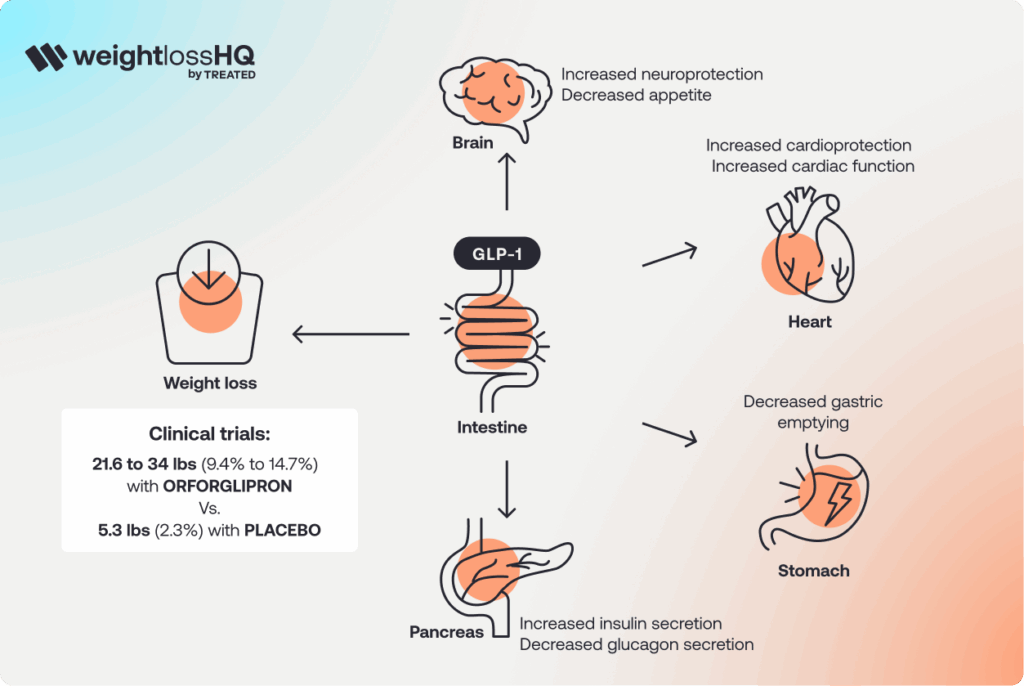
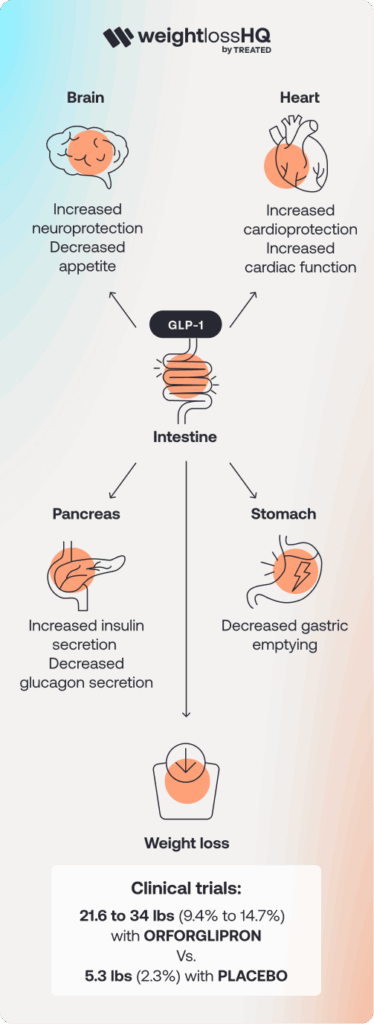
Orforglipron is a GLP-1 receptor agonist, which means it activates the same receptors as a hormone found naturally in your body called GLP-1, mimicking its effects in your body. These include:
Orforglipron is currently being tested in clinical trials to see if it can help treat type 2 diabetes and obesity, with promising early results.
Since orforglipron mimics the natural hormone GLP-1, which is found in organs like the kidney, liver, and heart, it’s also believed to offer benefits for other health conditions. These may include chronic kidney disease, non-alcoholic fatty liver disease, and heart disease.
Another GLP-1 receptor agonist, Wegovy, has already been FDA-approved to reduce the risk of cardiovascular problems like strokes, heart attacks, and cardiovascular death in people with cardiovascular disease alongside overweight or obesity. So orforglipron may have a similar potential for improving heart health.
However, Orforglipron hasn’t been approved for any of these conditions in the UK yet. Clinical trials are still underway to prove its safety and effectiveness. In the US, it’s currently only FDA-approved for weight loss.
Results from clinical studies show that Orforglipron (LY3502970) may help with both blood sugar control and weight loss.
In clinical trials, people with obesity who took Orforglipron saw significant weight loss. Over 36 weeks, those on a 12mg dose lost an average of 9.4% of their body weight or 21.6 pounds, while those on a 45mg dose lost 14.7% or 34 pounds. In comparison, the placebo group only lost 2.3% or 5.3 pounds. Between 46% and 75% of people taking Orforglipron (compared to just 9% in the placebo group) lost at least 10% of their body weight.
For people with type 2 diabetes, Orforglipron also showed very good results in lowering blood sugar. A phase 2 study found that it reduced HbA1c levels—an important measure of long-term blood sugar control—by up to 2.10%. This was better than dulaglutide (Trulicity), which lowered HbA1c by 1.10%, and much higher than the placebo group, which only saw a 0.43% drop.
Like other GLP-1 receptor agonists, Orforglipron is also believed to have potential benefits beyond blood sugar control and weight loss. Researchers think it may help with kidney, liver, and heart disease, though more studies are needed to confirm these effects.
Orforglipron has some advantages compared to other GLP-1 agonists. Unlike Wegovy or Mounjaro, which are injectable peptides, Orforglipron is a small, non-peptide molecule. This means it can be made into a pill that you can take by mouth, which is more convenient for some people than injectable medications.
Because it’s smaller and simpler to make, Orforglipron pills will also likely be cheaper to produce, store, and package. This could make it more affordable and easier to access, as it wouldn’t face the same supply shortages that sometimes affect injectable treatments.
Orforglipron is also less likely to become less effective over time, so you might not develop resistance as quickly as with other GLP-1 agonists. This is because it has a greater effect on a process called cAMP signaling (which regulates functions like metabolism and hormone release) and less effect on β-arrestin recruitment (which helps turn off cell receptors once they’ve been activated).
What’s more, clinical trials suggest that Orforglipron may be even more effective than GLP-1 injections like Wegovy or Mounjaro for weight loss.
Early data suggests that Orforglipron could be more effective than semaglutide (Wegovy) and tirzepatide (Mounjaro).
Here’s how the highest doses of these weight loss medications compared in clinical trials:
It’s difficult to directly compare these treatments, since the clinical trials had different conditions like BMI, population size, and treatment duration.
But it seems that Orforglipron 45mg was similarly effective to Wegovy 2.4mg in just over half the time. This suggests that Orforglipron might work faster than other GLP-1 agonists.
Since Orforglipron is a small molecule rather than a peptide-based medication like Wegovy and Mounjaro, it’s absorbed more easily by the body. This allows more of the drug to reach the bloodstream and work effectively.
Orforglipron also affects key processes that regulate hormone levels and receptor sensitivity, like cAMP signaling and β-arrestin recruitment. Because of this, you may be less likely to develop resistance to the medication over time than you would with other GLP-1 agonists.
So although there hasn’t been a direct study comparing it to other GLP-1 agonists for weight loss, early results suggest that Orforglipron could be just as or even more effective than Wegovy and Mounjaro.
Like all medications, Orforglipron can have potential side effects. Similar to other GLP-1 medications, the most common side effects in clinical trials were gastrointestinal issues, such as nausea, vomiting, constipation, diarrhoea, and acid reflux.
These side effects are dose-dependent, meaning they become more intense at higher doses. And they usually get better over time, as your body adjusts to the medication.
More clinical trials are currently underway with a larger group of people to look into any possible serious side effects.
Orforglipron has been approved in the US under the brand name Foundayo, however it has not yet been licensed in other parts of the world, including the UK and other parts of Europe. It is, however, expected to be licensed and approved for weight loss soon.
The future of GLP-1 medications is looking more convenient and accessible. As scientists continue to improve how often and how these medications are taken, we can expect them to become easier to use, with fewer side effects and a lower price tag.
Right now, most GLP-1s require daily or weekly doses. But in the coming years we could see options that only need to be taken once a month or even less, making it even easier for people to manage conditions like type 2 diabetes and obesity.
Although Orforglipron hasn’t been approved in the UK yet, there are other medications currently available for weight loss. Here are some examples:
But no matter which treatment option you choose, these medications work best when combined with a balanced diet and regular physical activity.
Most of these medications, except for Alli, need a prescription. In most cases, you’ll qualify to get a prescription from your doctor if you have a BMI of 30 or higher or a BMI of 27 or higher with weight-related health issues like type 2 diabetes or cardiovascular disease.
Daily Oral GLP-1 Receptor Agonist Orforglipron for Adults with Obesity. The New England Journal of Medicine, 389(10).
Glucagon-like peptide-1 receptor: mechanisms and advances in therapy. Signal Transduction and Targeted Therapy, 9(1), pp.1–29.
The benefits of GLP1 receptors in cardiovascular diseases. Frontiers in clinical diabetes and healthcare, 8(4): 1293926.
Efficacy and safety of oral orforglipron in patients with type 2 diabetes: a multicentre, randomised, dose-response, phase 2 study. The Lancet, 402(10400), pp. 472 - 483.
The potential of GLP-1 receptor agonists in type 2 diabetes and chronic kidney disease: from randomised trials to clinical practice. Therapeutic Advances in Endocrinology and Metabolism, 13, p.20420188221112490.
Glucagon-Like Peptide-1 Receptor Agonists for Treatment of Nonalcoholic Fatty Liver Disease and Nonalcoholic Steatohepatitis: An Updated Meta-Analysis of Randomized Controlled Trials. Metabolites, 11(2), p.73.
FDA Approves First Treatment to Reduce Risk of Serious Heart Problems Specifically in Adults with Obesity or Overweight.
Once-Weekly Semaglutide in Adults with Overweight or Obesity. The New England Journal of Medicine, 384(11), pp.989–1002.
Tirzepatide Once Weekly for the Treatment of Obesity. The New England Journal of Medicine, 387(3).
Orforglipron, a novel non‐peptide oral daily glucagon‐like peptide‐1 receptor agonist as an anti‐obesity medicine: A systematic review and meta‐analysis. Obesity science & practice, 10(2).
How we source info.
When we present you with stats, data, opinion or a consensus, we’ll tell you where this came from. And we’ll only present data as clinically reliable if it’s come from a reputable source, such as a state or government-funded health body, a peer-reviewed medical journal, or a recognised analytics or data body. Read more in our editorial policy.
Have a subject you’d like us to cover in a future article? Let us know.
We're making healthcare more about you. Sign up to our newsletter for personalised health articles that make a difference.
Disclaimer: The information provided on this page is not a substitute for professional medical advice, diagnosis, or treatment. If you have any questions or concerns about your health, please talk to a doctor.
We couldn't find what you're looking for.
Here's everything we treat. Or, if you're looking for something we don't have yet, you can suggest something.
By clicking 'Subscribe now' you're agreeing to our Privacy Policy.
(And leave your email too, so we can let you know if we write an article based on your suggestion.)
Last updated on May 14, 2026.
Our experts continually monitor new findings in health and medicine, and we update our articles when new info becomes available.
Why this page was updated on May 14, 2026
Current version (May 14, 2026)
Edited by: The Treated Content Team.May 06, 2025
Published by: The Treated Content Team. Medically reviewed by: Mr Craig Marsh, Independent PrescriberHow we source info.
When we present you with stats, data, opinion or a consensus, we’ll tell you where this came from. And we’ll only present data as clinically reliable if it’s come from a reputable source, such as a state or government-funded health body, a peer-reviewed medical journal, or a recognised analytics or data body. Read more in our editorial policy.